
Customer support has become one of the most important factors influencing customer retention, brand reputation, and long-term business growth. Businesses across the USA are investing heavily in customer service platforms that can automate workflows, improve response times, and create better customer experiences.
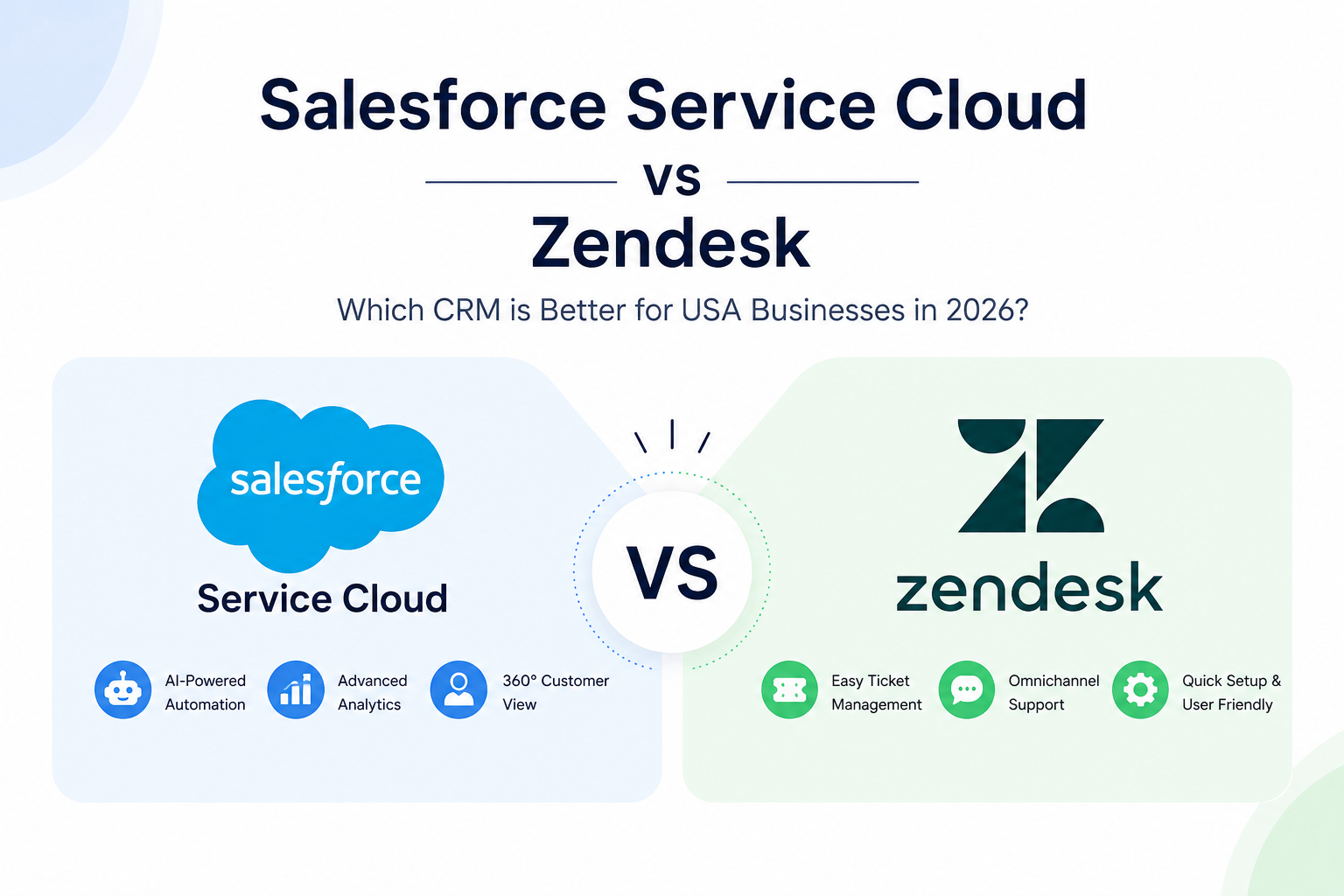
Two of the most popular customer support platforms in the market today are salesforce service cloud vs zendesk USA. Both platforms offer customer service automation, ticket management, omnichannel communication, and analytics, but they are designed for different business needs and operational goals.
For businesses planning to invest in a scalable customer support system, understanding the difference between Salesforce Service Cloud vs Zendesk USA is critical. In this guide, we compare features, pricing, integrations, automation, scalability, and overall business value to help you choose the right solution in 2026.
What is Salesforce Service Cloud?
Salesforce Service Cloud is an enterprise-level customer service platform built within the Salesforce ecosystem. It helps businesses manage customer support operations, automate workflows, handle omnichannel communication, and improve customer satisfaction.
Because it is deeply connected with Salesforce CRM, Service Cloud provides businesses with a complete customer view across sales, marketing, and support teams.
Salesforce Service Cloud is commonly used by:
- Mid-sized businesses
- Enterprises
- SaaS companies
- Healthcare organizations
- Financial services companies
- Large customer support teams
Its main strength lies in automation, scalability, AI-powered workflows, and deep CRM integration.
Businesses looking to improve customer support operations often invest in salesforce service cloud consultant USA solutions to automate workflows, improve response times, and enhance customer experience.
What is Zendesk?
Zendesk is a cloud-based customer support platform focused primarily on ticketing and helpdesk management. It is known for its simple interface, quick setup, and ease of use.
Zendesk is commonly used by:
- Startups
- Small businesses
- E-commerce companies
- Customer support teams looking for quick deployment
Zendesk focuses heavily on support ticket management, live chat, and customer communication.
While Zendesk is user-friendly and efficient for smaller operations, businesses often outgrow it as workflows become more complex.
salesforce service cloud vs zendesk USA: Key Differences
Although both platforms focus on customer support, they serve different business needs.
| Feature | Salesforce Service Cloud | Zendesk |
|---|---|---|
| Primary Focus | Enterprise CRM + Support | Helpdesk & Ticketing |
| Best For | Medium to Enterprise Businesses | Small to Mid Businesses |
| CRM Integration | Native Salesforce Ecosystem | Third-Party Integrations |
| Automation | Advanced AI Automation | Basic to Moderate Automation |
| Customization | Highly Customizable | Limited Customization |
| Scalability | Enterprise-Level | Moderate |
| Reporting | Advanced Analytics | Standard Reporting |
| Omnichannel Support | Advanced | Good |
| AI Capabilities | Salesforce Einstein AI | Limited AI Features |
The biggest difference is that Salesforce Service Cloud is part of a larger CRM ecosystem, while Zendesk mainly focuses on customer support operations.
Why USA Businesses Choose Salesforce Service Cloud
Businesses in the USA increasingly prefer Salesforce Service Cloud because of its scalability and enterprise-level capabilities.
Modern companies require:
- Unified customer data
- AI-powered workflows
- Sales and support alignment
- Advanced automation
- Real-time analytics
- Scalable customer support infrastructure
Salesforce Service Cloud provides all of these capabilities within a centralized ecosystem.
For growing businesses, especially in SaaS, healthcare, finance, and enterprise operations, Salesforce offers a long-term scalable solution.
Why Some Businesses Choose Zendesk
Zendesk remains popular because it is easier to implement and requires less technical setup.
Businesses often choose Zendesk because:
- Quick deployment
- Lower upfront costs
- Simple user interface
- Easy ticket management
- Fast onboarding
For startups or small support teams with limited technical requirements, Zendesk can be a practical short-term solution.
However, as businesses scale, many organizations eventually migrate from Zendesk to Salesforce Service Cloud for better automation and CRM integration.
Automation Capabilities Comparison
Automation is one of the biggest deciding factors when comparing Salesforce Service Cloud vs Zendesk USA.
Salesforce Service Cloud Automation
Salesforce offers advanced workflow automation using:
- Salesforce Flow
- Einstein AI
- Case routing automation
- Predictive support
- Automated approvals
- Intelligent escalations
Businesses can automate complex customer support operations while integrating support workflows with sales and marketing systems.
Zendesk Automation
Zendesk provides basic automation features including:
- Ticket assignment
- Trigger-based workflows
- SLA management
- Email automation
While effective for smaller support operations, Zendesk automation is not as advanced or scalable as Salesforce Service Cloud.
CRM Integration Comparison
One major advantage of Salesforce Service Cloud is native CRM integration.
Because Service Cloud is built within Salesforce CRM, businesses gain access to:
- Complete customer history
- Sales pipeline visibility
- Marketing interactions
- Customer purchase behavior
- Cross-department collaboration
Zendesk requires third-party integrations for CRM functionality, which can create data silos and operational complexity.
For businesses wanting a connected ecosystem, Salesforce Service Cloud is a stronger long-term solution.
Many growing companies also rely on salesforce integration services USA to connect CRM systems with support, marketing, and operational platforms for better efficiency.
Reporting and Analytics
Data-driven decision-making is critical for customer service optimization.
Salesforce Service Cloud Reporting
Salesforce provides:
- Advanced dashboards
- Real-time analytics
- AI-driven insights
- Predictive reporting
- Custom KPI tracking
Businesses can analyze customer behavior, support efficiency, agent performance, and operational trends in real time.
Zendesk Reporting
Zendesk provides standard support reporting such as:
- Ticket volume
- Agent performance
- Resolution time
- Customer satisfaction metrics
While useful, reporting capabilities are less advanced compared to Salesforce.
Scalability for Growing Businesses
Scalability is where Salesforce Service Cloud clearly outperforms Zendesk.
As businesses grow, they require:
- Advanced automation
- Multi-department collaboration
- Enterprise workflows
- AI-driven support systems
- Large-scale integrations
Salesforce Service Cloud is designed for enterprise scalability and supports long-term digital transformation.
Zendesk works well for smaller businesses but may become limiting for organizations with complex operational needs.
Pricing Comparison
Salesforce Service Cloud Pricing
Salesforce Service Cloud pricing is generally higher because it offers enterprise-level features and customization.
Pricing depends on:
- User count
- Automation requirements
- Integrations
- AI features
- Support level
Implementation costs may also vary depending on customization complexity.
Zendesk Pricing
Zendesk typically offers lower upfront costs and simpler pricing structures.
It is often considered budget-friendly for startups and smaller businesses.
However, businesses should also consider long-term scalability and integration costs before making a decision.
Which Platform is Better for USA Businesses in 2026?
The answer depends on your business size, goals, and operational complexity.
Choose Salesforce Service Cloud if:
- You need enterprise-level scalability
- You want advanced automation
- You require CRM integration
- You need AI-powered support workflows
- Your business is growing rapidly
Choose Zendesk if:
- You need simple ticket management
- You want quick setup
- You have a small support team
- Your workflows are basic
For most medium and large businesses in the USA, Salesforce Service Cloud provides stronger long-term value and scalability.
Why Businesses Are Migrating from Zendesk to Salesforce
Many growing businesses eventually transition from Zendesk to Salesforce Service Cloud because they outgrow basic support systems.
Common reasons include:
- Need for better CRM integration
- Advanced automation requirements
- Complex workflows
- Improved analytics
- Better scalability
Salesforce enables businesses to create a connected ecosystem where support, sales, and marketing work together seamlessly.
Future of Customer Support in 2026
Customer support is evolving rapidly with AI, automation, and predictive service technologies.
Businesses in 2026 will increasingly rely on:
- AI-powered customer service
- Omnichannel communication
- Predictive support analytics
- Automated workflows
- Personalized customer experiences
Salesforce Service Cloud is better positioned to support these future trends because of its advanced ecosystem and AI capabilities.
Final Thoughts
Choosing between Salesforce Service Cloud vs Zendesk USA depends on your current business needs and long-term growth strategy.
Zendesk is a strong option for startups and small businesses looking for simple helpdesk functionality. However, Salesforce Service Cloud provides significantly greater value for businesses seeking scalability, automation, CRM integration, and enterprise-level customer support solutions.
For businesses in the USA, UK, and Canada planning long-term digital growth, Salesforce Service Cloud offers a future-ready platform that can scale alongside evolving operational demands.
Investing in the right customer support platform today can significantly improve customer satisfaction, operational efficiency, and business growth in 2026 and beyond.
Get your free Salesforce Service cost estimate today and take the first step toward smarter, more efficient field operations.