
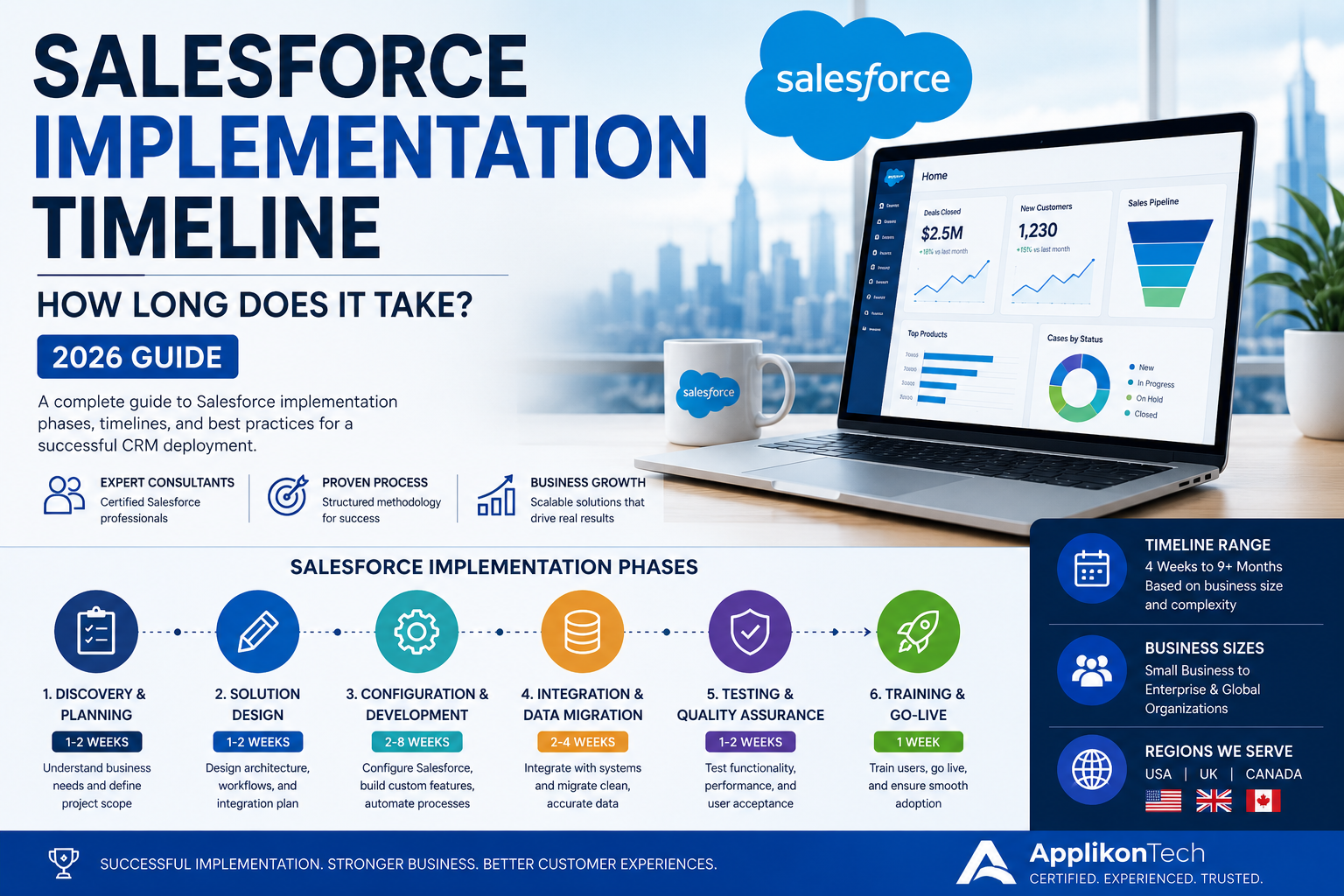

Implementing Salesforce is one of the most important investments a business can make to improve customer relationship management, automate operations, and accelerate digital transformation. However, before starting a Salesforce project, one question comes up in almost every boardroom:
How long does Salesforce implementation take?
The answer depends on several factors, including your business size, implementation complexity, number of users, custom development, integrations, data migration, and the Salesforce products you’re deploying.
Some businesses can launch Salesforce within a few weeks, while enterprise organizations may require several months to complete a successful implementation.
Understanding the Salesforce implementation timeline helps businesses plan resources, set realistic expectations, avoid unnecessary delays, and choose the right Salesforce consulting partner.
In this guide, you’ll learn the average Salesforce implementation timeline, the key phases involved, common factors that affect project duration, and practical strategies to ensure a successful CRM deployment.
What Is a Salesforce Implementation?
Salesforce implementation is the process of planning, configuring, customizing, integrating, testing, and deploying Salesforce based on your business requirements.
A successful implementation is not just about installing software—it involves aligning Salesforce with your business processes, customer journey, and long-term growth strategy.
A typical Salesforce implementation includes:
- Business discovery and requirement gathering
- CRM strategy and solution design
- Salesforce configuration
- Custom development
- Third-party integrations
- Data migration
- Testing and quality assurance
- User training
- Go-live deployment
- Post-launch optimization
Working with an experienced Salesforce implementation partner ensures every stage is completed efficiently while reducing risks and maximizing ROI.
Average Salesforce Implementation Timeline
The duration of a Salesforce implementation varies depending on the complexity of the project.
| Business Size | Typical Timeline |
|---|---|
| Small Business | 4–8 Weeks |
| Mid-Sized Business | 2–4 Months |
| Enterprise Organization | 4–9 Months |
| Large Digital Transformation Projects | 9–12+ Months |
Projects involving multiple Salesforce Clouds, complex workflows, AI capabilities, or enterprise integrations generally require additional planning and testing.
Factors That Affect the Salesforce Implementation Timeline
No two Salesforce projects are identical. Several factors influence how quickly your CRM can be deployed.
1. Business Requirements
The more complex your business processes, the longer the implementation.
For example:
- Standard CRM setup
- Multi-department workflows
- Approval processes
- AI automation
- Multi-country operations
Each additional requirement increases project complexity.
2. Salesforce Products
The number of Salesforce products being implemented directly affects the project timeline.
Examples include:
- Salesforce Sales Cloud
- Salesforce Service Cloud
- Salesforce Experience Cloud
- Salesforce Data Cloud
- Salesforce Revenue Cloud
- Salesforce CPQ
- Salesforce Field Service
Implementing multiple products requires additional configuration, testing, and user training.
3. Custom Development
Many businesses require custom Salesforce functionality.
Examples include:
- Lightning Web Components
- Apex Development
- Custom Objects
- Approval Workflows
- Automated Processes
- Custom Reports
- Dashboards
Custom development extends implementation time but provides a solution tailored to your business.
4. Data Migration
Migrating customer records, products, opportunities, contacts, and historical business data requires careful planning.
The quality of your existing data significantly affects migration speed.
Businesses with duplicate or incomplete records often spend additional time cleaning and validating data before migration.
5. Third-Party Integrations
Most organizations use multiple software applications.
Common Salesforce integrations include:
- SAP
- Oracle
- Microsoft Dynamics
- HubSpot
- Shopify
- QuickBooks
- Stripe
- Marketing Automation Platforms
The number and complexity of integrations directly influence the project timeline.
6. User Training & Change Management
A successful Salesforce implementation depends on user adoption.
Training sessions, documentation, workshops, and onboarding activities require additional time but significantly improve long-term success.
Organizations that skip training often experience poor CRM adoption after launch.
Salesforce Implementation Phases
Every successful Salesforce project follows a structured implementation methodology.
Phase 1: Discovery & Business Analysis (1–2 Weeks)
This phase focuses on understanding your business.
Activities include:
- Stakeholder meetings
- Business process analysis
- Requirement gathering
- Current CRM evaluation
- Project planning
- Success metrics
A thorough discovery phase reduces project risks later.
Phase 2: Solution Design (1–2 Weeks)
Salesforce architects design the CRM solution.
This includes:
- Solution Architecture
- Security Model
- Data Structure
- Automation Design
- User Roles
- Reporting Strategy
A strong design phase ensures scalability as your business grows.
Phase 3: Configuration & Development (2–8 Weeks)
This is where Salesforce is built.
Activities include:
- Salesforce Configuration
- Custom Development
- Workflow Automation
- Approval Processes
- Lightning Components
- Reports & Dashboards
- AI Configuration
For enterprise organizations, this phase often takes the longest.
Phase 4: Integration & Data Migration (1–4 Weeks)
Existing business systems are connected with Salesforce.
Common tasks include:
- API Integrations
- ERP Integration
- Marketing Automation Integration
- Payment Gateway Integration
- Customer Data Migration
- Data Validation
Successful data migration is critical for long-term CRM performance.
Phase 5: Testing & Quality Assurance (1–2 Weeks)
Before launch, every feature is thoroughly tested.
Testing includes:
- Functional Testing
- Security Testing
- Performance Testing
- User Acceptance Testing
- Bug Fixes
- Final Validation
This phase ensures the platform performs reliably under real-world conditions.
Phase 6: User Training & Go-Live (1 Week)
Before deployment, employees receive training to ensure they understand the new system.
Activities include:
- Administrator Training
- End-User Training
- Documentation
- Knowledge Transfer
- Go-Live Support
A well-planned launch helps improve user adoption and minimizes business disruption.
Why the Right Salesforce Consulting Partner Matters
One of the biggest factors influencing your implementation timeline is the consulting partner you choose.
An experienced Salesforce consulting company can:
- Reduce project delays
- Avoid costly implementation mistakes
- Improve communication
- Accelerate deployment
- Ensure data accuracy
- Deliver scalable CRM solutions
- Provide long-term support
Choosing the right Salesforce implementation partner often shortens the project timeline while improving the overall quality of the implementation.
Salesforce Implementation Timeline by Business Size
Every business has different implementation requirements. A startup with 10 users can often go live within a few weeks, while a global enterprise with multiple departments, custom workflows, and third-party integrations may require several months.
Below is a general timeline based on business size.
| Business Size | Users | Estimated Timeline |
|---|---|---|
| Small Business | 5–25 | 4–8 Weeks |
| Growing Business | 25–100 | 2–3 Months |
| Mid-Sized Company | 100–500 | 3–5 Months |
| Enterprise Organization | 500+ | 4–9 Months |
| Global Enterprise | Multiple Locations | 6–12+ Months |
While every project is different, following a structured implementation process helps reduce delays and ensures a successful Salesforce deployment.
Common Reasons Salesforce Implementations Get Delayed
Even well-planned Salesforce projects can experience delays if key challenges are not addressed early.
Some of the most common causes include:
Unclear Business Requirements
Projects often slow down when stakeholders continuously change requirements during development.
A detailed discovery workshop before implementation helps prevent scope changes.
Poor Data Quality
Migrating incomplete, outdated, or duplicate customer data requires additional cleaning and validation.
Businesses that prepare their data in advance usually complete implementations much faster.
Too Much Customization
Custom Lightning Components, Apex development, and complex approval workflows increase project duration.
Whenever possible, businesses should leverage standard Salesforce functionality before requesting custom development.
Complex Third-Party Integrations
Integrating Salesforce with ERP systems, accounting software, marketing platforms, payment gateways, or legacy applications requires additional planning, development, and testing.
Lack of User Involvement
If business users are not actively involved during testing and feedback sessions, issues are often discovered after deployment, leading to costly delays.
Insufficient User Training
A technically successful implementation can still fail if employees don’t know how to use Salesforce effectively.
Proper training improves user adoption and reduces post-launch support requests.
How to Speed Up Your Salesforce Implementation
A faster implementation doesn’t mean cutting corners—it means planning efficiently and avoiding unnecessary delays.
Here are some proven best practices:
- Clearly define business goals before starting the project.
- Prioritize essential features for the first phase.
- Clean and organize your data before migration.
- Assign internal project owners and decision-makers.
- Schedule regular project review meetings.
- Use standard Salesforce functionality wherever possible.
- Test each phase thoroughly before moving forward.
- Partner with an experienced Salesforce consulting company.
These practices help reduce project risks while accelerating deployment.
Common Salesforce Implementation Mistakes to Avoid
Many organizations make avoidable mistakes that increase costs and delay project completion.
Avoid these common pitfalls:
- Choosing the lowest-cost implementation partner instead of the most experienced.
- Starting development without clearly defined business requirements.
- Migrating poor-quality data.
- Ignoring end-user training.
- Over-customizing Salesforce unnecessarily.
- Skipping testing before go-live.
- Failing to plan for future scalability.
- Not investing in post-launch optimization and support.
Avoiding these mistakes helps businesses achieve faster deployment and a higher return on investment.
Why Choose ApplikonTech?
At ApplikonTech, we help businesses across the USA, UK, and Canada implement Salesforce faster, smarter, and with confidence.
Our certified Salesforce consultants combine technical expertise with business strategy to deliver scalable CRM solutions that improve productivity, customer experiences, and long-term business growth.
Our Salesforce Services
- Salesforce Consulting
- Salesforce Implementation
- Salesforce Development
- Salesforce Integration
- Salesforce Data Migration
- Salesforce Managed Services
- Salesforce Support
- Salesforce Sales Cloud
- Salesforce Service Cloud
- Salesforce Experience Cloud
- Salesforce Data Cloud
- Salesforce Revenue Cloud
- Salesforce CPQ
- Salesforce Field Service
Whether you’re implementing Salesforce for the first time or optimizing an existing environment, our team provides end-to-end support throughout your digital transformation journey.
Frequently Asked Questions
How long does Salesforce implementation take?
A typical Salesforce implementation takes 4–8 weeks for small businesses, 2–5 months for mid-sized organizations, and 4–9 months or more for enterprise implementations, depending on complexity.
What affects the Salesforce implementation timeline?
Key factors include business requirements, custom development, third-party integrations, data migration, user training, and the Salesforce products being implemented.
Can Salesforce implementation be completed faster?
Yes. A well-defined project scope, clean data, experienced consultants, and efficient project management can significantly reduce implementation time.
Which Salesforce Clouds take the longest to implement?
Projects involving Revenue Cloud, Data Cloud, Salesforce CPQ, and complex enterprise integrations typically require more time due to advanced configuration and testing.
Do you provide Salesforce implementation services in the USA, UK, and Canada?
Yes. ApplikonTech provides remote Salesforce consulting, implementation, integration, optimization, and managed services for businesses across North America and the United Kingdom.
Final Thoughts
A successful Salesforce implementation is about more than meeting a deadline—it’s about delivering a CRM platform that supports your business goals today and scales with you tomorrow.
While implementation timelines vary based on project complexity, choosing the right Salesforce consulting partner can dramatically reduce delays, improve user adoption, and maximize your return on investment.
By planning carefully, involving key stakeholders, preparing clean data, and following a proven implementation methodology, businesses can deploy Salesforce efficiently and achieve long-term success.
Ready to Start Your Salesforce Implementation?
Planning a Salesforce project and wondering how long it will take?
At ApplikonTech, our certified Salesforce consultants help businesses across the USA, UK, and Canada deliver Salesforce implementations on time and within budget. From strategy and planning to deployment, integrations, and ongoing support, we ensure your CRM is built for long-term success.
Why Businesses Trust ApplikonTech
- Certified Salesforce Consultants
- End-to-End Salesforce Implementation
- Sales Cloud, Service Cloud, Data Cloud & Revenue Cloud Experts
- Secure Data Migration & System Integration
- Flexible Engagement Models
- Dedicated Project Managers
- Ongoing Managed Services & Technical Support
Book Your Free Salesforce Consultation Today
Let’s discuss your project timeline, business goals, and implementation roadmap. Our experts will help you plan a Salesforce deployment that minimizes risks, accelerates adoption, and delivers measurable ROI.