

Planning to implement Salesforce in your business? One of the first questions you will probably ask is: How much does Salesforce implementation cost?
Salesforce is a flexible CRM platform that helps businesses manage customer relationships, sales operations, marketing activities, and customer service. However, the total investment goes beyond purchasing Salesforce licenses.
The overall Salesforce implementation cost depends on several factors, including business requirements, CRM complexity, customization, integrations, data migration, employee training, and ongoing support.
A small business implementing basic CRM functionality will have different requirements from an organization managing complex workflows, multiple departments, and enterprise integrations.
Understanding these cost factors before starting a project can help you create a realistic budget and avoid unexpected expenses.
In this guide, we break down Salesforce implementation costs in 2026, explain the factors that influence project pricing, compare implementation approaches, and share practical budgeting considerations for businesses.
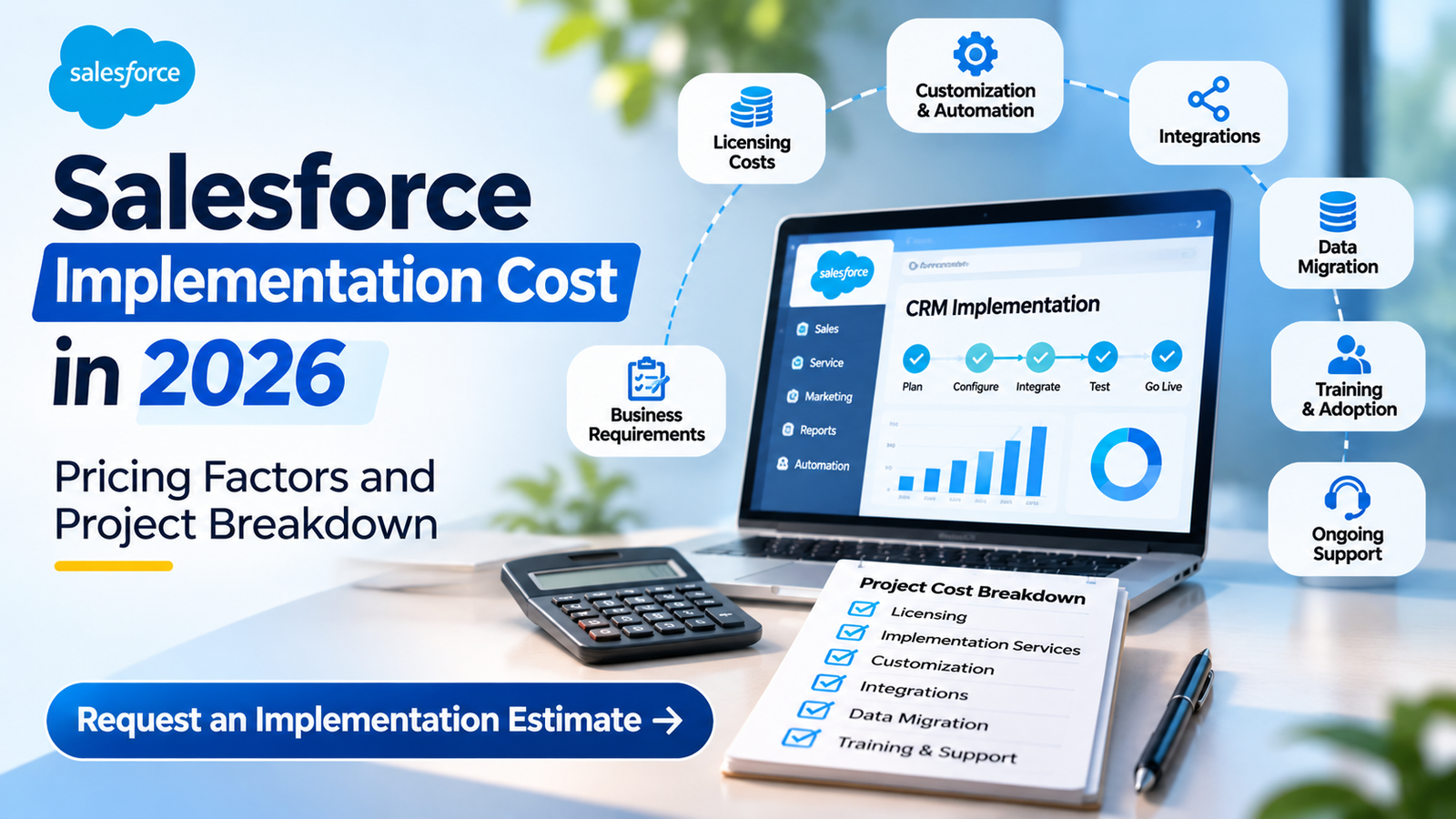
How Much Does Salesforce Implementation Cost in 2026?
There is no fixed price for Salesforce implementation because every business has different requirements.
The total investment typically includes:
- Salesforce software licenses.
- Consulting and implementation services.
- CRM configuration and customization.
- Data migration and cleansing.
- Third-party integrations.
- Employee training.
- Testing and deployment.
- Ongoing maintenance and support.
For planning purposes, businesses should request a project estimate based on their requirements rather than relying on a generic implementation price.
The following table provides an illustrative project-complexity framework, not verified market quotations or guaranteed pricing.
| Implementation type | Typical project scope | Cost complexity |
|---|---|---|
| Basic CRM setup | Standard configuration, users, basic reports | Low |
| Small business implementation | Sales processes, workflows, dashboards, basic migration | Low to Medium |
| Mid-sized implementation | Customization, automation, multiple integrations | Medium to High |
| Advanced implementation | Complex workflows, multiple departments, extensive integrations | High |
| Enterprise implementation | Complex architecture, multiple systems, large-scale migration | Very High |
Actual project costs depend on the scope, Salesforce edition, implementation partner, and technical requirements.
10 Factors That Affect Salesforce Implementation Cost
Understanding the factors behind implementation pricing helps businesses make better decisions and compare consulting proposals.
1. Salesforce Licensing Costs
Salesforce licensing is one of the first expenses to consider.
The required subscription depends on the Salesforce products, edition, features, and number of users.
For example, a business implementing Sales Cloud may have different licensing requirements from an organization using Sales Cloud, Service Cloud, Revenue Cloud, and additional platform capabilities.
Important licensing considerations include:
- Number of Salesforce users.
- Required Salesforce products and editions.
- Feature and storage requirements.
- Additional platform capabilities.
- Integration and API requirements.
- Third-party applications and add-ons.
Budget tip: Identify which Salesforce capabilities your business actually needs before purchasing licenses. Avoid paying for functionality that your team will not use.
2. Business Requirements and Project Complexity
The complexity of your business processes directly affects implementation effort.
A company with a straightforward sales pipeline may require basic CRM configuration.
However, businesses with multiple sales teams, different approval processes, complex customer journeys, and several departments may require additional planning and development.
Before requesting a quotation, document:
- Current business processes.
- Sales and customer service workflows.
- User roles and permissions.
- Reporting requirements.
- Automation opportunities.
- Required business outcomes.
A clear scope helps consultants estimate project effort more accurately.
3. Salesforce Customization
Customization involves modifying Salesforce functionality to meet specific business requirements.
Common customization activities include:
- Custom objects and fields.
- Page layouts and record types.
- Custom dashboards and reports.
- Salesforce Flow automation.
- Approval workflows.
- Custom Apex development.
- Lightning Web Components.
Standard Salesforce functionality should be evaluated first. Unnecessary customization can increase implementation time, testing effort, and future maintenance costs.
4. Data Migration Costs
Businesses moving from spreadsheets, legacy CRMs, or other databases need to plan their data migration carefully.
The cost depends on:
- Total records being migrated.
- Number of data sources.
- Data quality and duplication.
- Field mapping complexity.
- Relationships between records.
- Historical data requirements.
- Data validation and testing.
For example, migrating a clean customer database may be relatively straightforward. Moving data from multiple legacy systems with inconsistent formats and duplicate records requires more effort.
A proper migration plan should include data cleansing, mapping, test migration, validation, and final deployment.
5. Third-Party Integration Costs
Many businesses use multiple applications to manage daily operations.
Salesforce may need to connect with:
- ERP platforms.
- Accounting software.
- Marketing automation tools.
- E-commerce platforms.
- Payment systems.
- Customer support applications.
- Internal business databases.
Integration costs depend on API availability, system architecture, data synchronization requirements, middleware, and error-handling processes.
Businesses should document all required integrations before implementation begins.
6. Workflow Automation Costs
Salesforce automation can reduce repetitive work and improve operational efficiency.
Examples include:
- Automatic lead assignment.
- Follow-up task creation.
- Email notifications.
- Approval workflows.
- Opportunity updates.
- Customer service case routing.
- Automated reporting.
Simple workflows may be configured using standard Salesforce tools. More complex automation may require additional development and testing.
7. Employee Training and Adoption
Salesforce implementation is not complete when the technical setup is finished.
Employees need to understand how to use the platform correctly.
Training costs may include:
- Administrator training.
- Sales team training.
- Customer service training.
- Manager and reporting training.
- User documentation.
- Adoption support.
Insufficient training can lead to poor CRM adoption, inconsistent data entry, and underutilization of the platform.
8. Testing and Quality Assurance
Testing is an important part of implementation and should be included in the project budget.
It helps identify problems before employees begin using the new CRM environment.
Testing activities may include:
- Functional testing.
- Integration testing.
- Data validation.
- Workflow testing.
- User acceptance testing.
- Security and permission testing.
- Regression testing.
The level of testing depends on the complexity and business impact of the implementation.
9. Consulting Partner Fees
The Salesforce consulting partner you select can significantly influence project cost.
Consulting fees depend on factors such as:
- Consultant experience.
- Technical specialization.
- Project duration.
- Number of resources.
- Implementation methodology.
- Custom development requirements.
- Support arrangements.
A qualified consulting partner should provide a transparent proposal that explains the project scope, deliverables, resources, assumptions, and exclusions.
10. Ongoing Maintenance and Support
Salesforce requires ongoing administration and optimization as business requirements change.
Post-implementation expenses may include:
- User administration.
- Troubleshooting.
- Workflow improvements.
- Dashboard updates.
- Integration maintenance.
- Security and access reviews.
- New feature development.
- Technical support.
Include ongoing support in your long-term budget instead of considering implementation a one-time expense.
Salesforce Implementation Cost by Business Size
Business size can influence the number of users, workflows, integrations, and resources required.
However, employee count alone does not determine implementation cost. A small business with complex pricing and integration requirements may need more implementation effort than a larger company with simple CRM requirements.
Small Businesses (10–20 Employees)
Small businesses often need a straightforward CRM environment to manage leads, contacts, sales activities, and customer communication.
Common requirements include:
- Basic Salesforce configuration.
- Lead and opportunity management.
- Contact management.
- Standard dashboards and reports.
- Simple automation.
- Limited data migration.
Budget considerations: Prioritize essential CRM functionality and avoid unnecessary customization.
Growing Businesses (21–50 Employees)
Growing businesses may require more structured workflows and better visibility across sales and operations.
Common requirements include:
- Advanced sales pipeline configuration.
- Multiple user roles.
- Custom dashboards.
- Automated workflows.
- Third-party integrations.
- Data migration.
- User training.
Budget considerations: Focus on scalability, integration requirements, and process standardization.
Larger Organizations (50+ Employees)
Organizations with more users and departments may need a broader Salesforce implementation.
Common requirements include:
- Complex business workflows.
- Multiple Salesforce products.
- Advanced security and permissions.
- Extensive integrations.
- Custom development.
- Enterprise reporting.
- Dedicated administration and support.
Budget considerations: Plan for architecture, project governance, testing, data management, and long-term maintenance.
Salesforce Implementation Pricing Models
Salesforce consulting companies may use different pricing models depending on the project.
Understanding these models can help businesses choose the right engagement approach.
1. Fixed-Price Project
Under a fixed-price model, the consulting partner agrees on a defined scope and project price.
This approach can work well when requirements and deliverables are clearly documented.
Suitable for:
- Basic CRM implementation.
- Clearly defined configuration projects.
- Projects with limited customization.
2. Hourly Consulting
In an hourly model, businesses pay for the time spent by consultants and technical resources.
This can be suitable for ongoing consulting, troubleshooting, or projects where requirements may evolve.
Suitable for:
- Technical support.
- CRM optimization.
- Small enhancements.
- Consulting and advisory services.
3. Monthly Retainer
A monthly retainer provides ongoing access to consulting or technical support based on an agreed scope and resource allocation.
Suitable for:
- Salesforce administration.
- Managed services.
- Ongoing optimization.
- Regular technical assistance.
4. Dedicated Resource Model
Businesses can engage dedicated Salesforce professionals to support internal teams or specific projects.
Suitable for:
- Continuous development.
- Long-term implementation programs.
- Additional technical capacity.
- Internal team support.
| Pricing model | Best suited for | Key consideration |
|---|---|---|
| Fixed price | Defined projects | Scope must be clear |
| Hourly | Flexible consulting | Monitor resource usage |
| Monthly retainer | Ongoing support | Define monthly deliverables |
| Dedicated resources | Long-term work | Define roles and responsibilities |
Hidden Salesforce Implementation Costs Businesses Should Consider
Some expenses are overlooked during initial project planning.
These may increase the overall cost of ownership if they are not identified early.
Additional Software Licenses
Your business may need additional Salesforce products, user licenses, storage, or third-party applications as requirements evolve.
Integration Maintenance
Connected systems may require ongoing API updates, monitoring, and troubleshooting.
Data Cleansing
Poor-quality legacy data may require additional preparation before migration.
Scope Changes
New requirements introduced after project approval can increase development time and cost.
Post-Launch Enhancements
Businesses often identify additional automation, reporting, and customization opportunities after employees begin using Salesforce.
Employee Change Management
Training, documentation, and internal communication may require additional time and resources.
A realistic project estimate should account for these potential expenses.
How to Reduce Salesforce Implementation Costs
Businesses can control implementation costs without compromising essential functionality.
1. Define Requirements Before Starting
Document your business processes, objectives, and essential CRM features.
Avoid adding unnecessary requirements during implementation.
2. Start With Standard Salesforce Features
Evaluate standard Salesforce functionality before investing in custom development.
3. Prioritize Integrations
Identify which integrations are essential for launch and which can be introduced later.
4. Clean Data Before Migration
Preparing accurate data before migration can reduce rework and validation issues.
5. Implement in Phases
Instead of implementing everything at once, prioritize the most important business processes.
For example:
- Phase 1: Core CRM setup.
- Phase 2: Automation and reporting.
- Phase 3: Integrations and advanced customization.
- Phase 4: Optimization and additional capabilities.
6. Choose the Right Consulting Partner
Compare consulting partners based on technical expertise, project methodology, deliverables, and pricing transparency.
The cheapest proposal is not always the most cost-effective solution.
How to Estimate Your Salesforce Implementation Budget
Before requesting proposals, prepare a basic project requirements document.
Include the following information:
| Requirement | Information to prepare |
|---|---|
| Business size | Number of employees and Salesforce users |
| Salesforce products | Sales Cloud, Service Cloud, Revenue Cloud, etc. |
| Current CRM | Existing platform or spreadsheets |
| Data migration | Number of records and data sources |
| Customization | Required fields, objects, automation |
| Integrations | ERP, accounting, marketing, and other tools |
| Training | Number of employees requiring training |
| Timeline | Desired project start and launch |
| Support | One-time implementation or ongoing assistance |
Share these details with your consulting partner to receive a more realistic estimate.
Why Consider ApplikonTech for Salesforce Implementation?
Selecting the right Salesforce implementation partner can help your business avoid unnecessary complexity and make better use of its CRM investment.
ApplikonTech provides Salesforce consulting and technical services, including implementation, customization, integration, and ongoing support.
For businesses evaluating Salesforce implementation costs, the first step should be understanding the actual requirements rather than estimating the budget based only on employee count.
A project discussion can cover:
- Your current CRM environment.
- Required Salesforce products and features.
- Business workflows and automation.
- Data migration and integration needs.
- Customization requirements.
- Implementation priorities.
- Ongoing support expectations.
This helps establish a clearer project scope and identify the resources required for implementation.
Request an Implementation Estimate
Share your business requirements with ApplikonTech to discuss your Salesforce implementation scope, technical needs, and potential project costs.
Frequently Asked Questions
1. How much does Salesforce implementation cost in 2026?
Salesforce implementation costs vary depending on licensing, business requirements, customization, data migration, integrations, and consulting fees. A project-specific estimate is more reliable than a generic price.
2. Is Salesforce licensing included in implementation costs?
Not necessarily. Salesforce subscription fees and consulting implementation fees are generally separate expenses. Always check whether a proposal includes software licenses or only implementation services.
3. How long does Salesforce implementation take?
The timeline depends on the number of users, project scope, customization, integration complexity, data migration, and testing requirements.
4. Is Salesforce suitable for small businesses?
Yes. Small businesses can use Salesforce to manage leads, customer relationships, sales activities, and business workflows. The appropriate edition and implementation scope depend on their requirements and budget.
5. What is the biggest factor affecting Salesforce implementation cost?
There is no single biggest factor for every project. Customization, integrations, data migration, project complexity, and licensing can all significantly influence the total investment.
6. Can I reduce Salesforce implementation costs?
Yes. Start with clearly defined requirements, use standard functionality where possible, clean data before migration, prioritize essential integrations, and implement in phases.
7. Should I hire a Salesforce consulting partner?
A consulting partner can help with requirement analysis, architecture, configuration, integrations, migration, testing, and training. Whether you need one depends on your internal team’s experience and project complexity.
8. Does Salesforce implementation include ongoing support?
Not automatically. Support arrangements vary by consulting partner and project agreement. Confirm whether maintenance, troubleshooting, administration, and future enhancements are included.
Final Thoughts
Understanding Salesforce implementation costs requires looking beyond software licensing.
The total investment depends on your business processes, technical requirements, customization, integrations, data migration, training, and ongoing support.
Small businesses should prioritize essential CRM functionality, while growing organizations should consider scalability, automation, and integration requirements.
Before selecting an implementation partner, request a transparent proposal with clear deliverables, milestones, assumptions, and pricing.
Planning to implement Salesforce in 2026?
Connect with ApplikonTech to discuss your business requirements and receive guidance on your Salesforce implementation scope.