

Businesses today need more than just a CRM platform to manage customer relationships, sales activities, and business operations. They need a well-planned strategy that connects technology with business goals. This is where Salesforce consulting services can make a difference.
Salesforce offers a range of cloud-based solutions for sales, customer service, marketing, analytics, and business process automation. However, implementing and managing these tools effectively requires the right expertise, technical planning, and ongoing optimization.
Choosing the right Salesforce consulting partner can help businesses improve CRM adoption, streamline workflows, connect business systems, and make better use of their customer data.
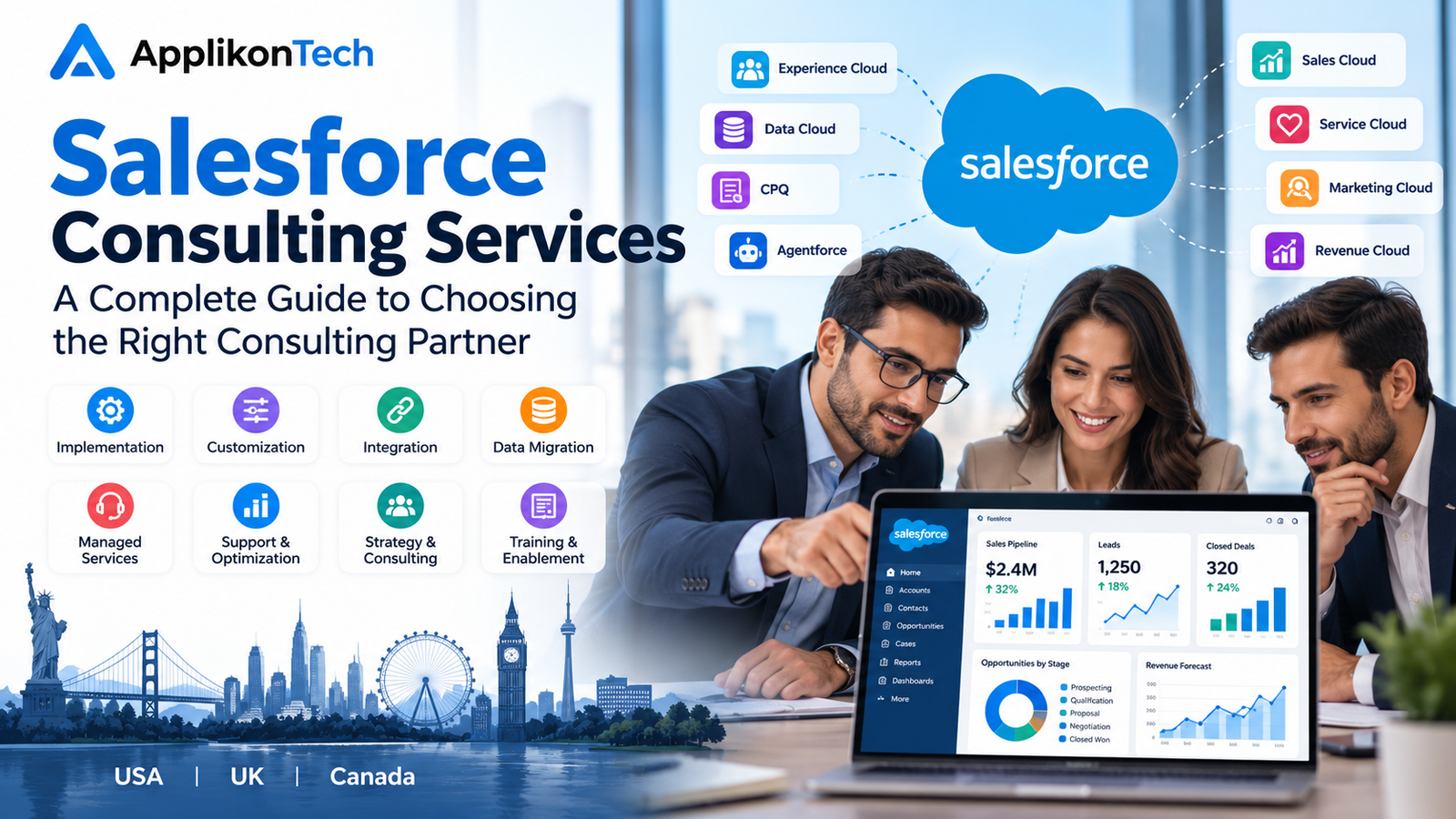
What Are Salesforce Consulting Services?
Salesforce consulting services help businesses plan, implement, customize, integrate, and optimize their Salesforce environment according to their operational requirements.
A Salesforce consulting team evaluates your current processes, identifies gaps, and recommends solutions that align with your business objectives.
Common Salesforce consulting services include:
- Salesforce implementation: Setting up Salesforce according to business requirements and workflows.
- CRM customization: Configuring objects, fields, dashboards, reports, and automation.
- Salesforce integration: Connecting Salesforce with ERP platforms, marketing tools, payment systems, and other business applications.
- Data migration: Transferring customer and business data into Salesforce with appropriate validation and mapping.
- Salesforce optimization: Reviewing existing configurations and identifying opportunities to improve performance and usability.
- Managed services and support: Providing ongoing assistance, maintenance, troubleshooting, and enhancements.
The right combination of services depends on your business size, existing technology, internal expertise, and long-term goals.
Why Does Your Business Need a Salesforce Consulting Company?
Salesforce is a flexible platform, but configuring it without a clear strategy can lead to unnecessary complexity, poor user adoption, inconsistent data, and inefficient workflows.
Working with an experienced Salesforce consulting company can help address these challenges.
1. Align Salesforce With Business Goals
A consultant should first understand your sales process, customer journey, reporting requirements, and operational challenges. This helps ensure that Salesforce supports your actual business needs instead of simply reproducing existing processes.
2. Improve Workflow Efficiency
Salesforce automation can reduce repetitive manual tasks, standardize processes, and help teams manage leads, opportunities, customer requests, and follow-ups more consistently.
3. Integrate Business Systems
Many businesses rely on several tools to manage their operations. Salesforce integration can help connect these systems and reduce data silos, subject to the capabilities and requirements of each platform.
4. Improve Reporting and Visibility
Well-designed dashboards and reports can give managers better visibility into sales pipelines, service performance, and business activity. The usefulness of these reports depends on data quality and appropriate configuration.
5. Support Future Growth
A thoughtfully designed Salesforce environment can be easier to maintain and expand as your business adds users, services, workflows, and integrations.
How to Choose the Right Salesforce Consulting Partner
Selecting a Salesforce consulting partner is an important business decision. Before committing to a project, evaluate the following factors.
1. Relevant Salesforce Experience
Look for experience related to your specific requirements, such as CRM implementation, Sales Cloud, Service Cloud, Revenue Cloud, integrations, data migration, or ongoing support.
Ask prospective partners about comparable projects, the challenges involved, and how they measured the results.
2. Certified Salesforce Consultants
Certifications can demonstrate knowledge of particular Salesforce products, roles, and technical areas. However, certifications alone do not guarantee project success.
Evaluate the team’s practical experience, communication, problem-solving ability, and familiarity with your business processes alongside its credentials.
3. Clear Project Scope and Deliverables
A reliable Salesforce consulting firm should explain what the project includes, what it excludes, which resources are required, and how progress will be evaluated.
The proposal should clearly define deliverables, milestones, responsibilities, testing, training, and post-launch support.
4. Communication and Collaboration
Your consulting partner should be able to explain technical decisions in business terms, document important decisions, and work with your internal stakeholders.
Regular progress updates and a clear escalation process can help prevent misunderstandings during implementation.
5. Security and Data Management
Discuss user access, permissions, data migration, backup and recovery requirements, testing, and any applicable regulatory obligations. Your partner should understand the sensitivity of your customer and business data.
6. Ongoing Support and Optimization
Salesforce requirements can change after launch. Ask whether the provider offers ongoing support, configuration updates, troubleshooting, performance reviews, and guidance as your business evolves.
Salesforce Consulting Services USA: What Should Businesses Consider?
Businesses looking for Salesforce consulting services USA should evaluate providers based on expertise, project fit, communication, and total cost—not location alone.
Before selecting a provider, consider:
- Industry experience: Does the team understand your business model and operational requirements?
- Time-zone coverage: Can the team collaborate with your stakeholders during important working hours?
- Project communication: Are meetings, reporting, documentation, and escalation procedures clearly defined?
- Pricing transparency: Are implementation, integration, training, and ongoing support costs explained separately?
- Long-term compatibility: Can the provider support your Salesforce environment after the initial project?
Companies should compare proposals using the same scope and deliverables to make a meaningful assessment of price and value.
What Factors Affect Salesforce Consulting Costs?
The cost of Salesforce consulting varies depending on project complexity, business requirements, and the expertise required. There is no single price that applies to every implementation.
Important cost factors include:
- The number of Salesforce products and business processes involved.
- The level of customization and automation required.
- The volume and quality of data being migrated.
- The number and complexity of third-party integrations.
- Reporting, security, and compliance requirements.
- User training, testing, and post-launch support.
- The engagement model, such as a fixed-scope project or ongoing consulting.
To evaluate a proposal effectively, request a detailed breakdown of deliverables, assumptions, dependencies, potential additional costs, and support arrangements.
Common Mistakes to Avoid When Hiring a Salesforce Consulting Firm
Businesses can reduce implementation risks by avoiding several common mistakes:
- Choosing a provider based only on the lowest quote.
- Starting implementation without documenting business requirements.
- Over-customizing Salesforce when standard functionality may be sufficient.
- Ignoring data quality and migration planning.
- Underestimating user training and change management.
- Failing to define success metrics and acceptance criteria.
- Overlooking ongoing maintenance and support.
A structured discovery process, realistic project plan, and clear communication can help businesses make more informed decisions.
Why Consider ApplikonTech for Salesforce Consulting?
ApplikonTech provides a starting point for businesses exploring Salesforce consulting and implementation support. When evaluating ApplikonTech or any other provider, discuss your current CRM environment, business objectives, integration requirements, project timeline, and expected deliverables.
A consultation can help identify your priorities and determine which Salesforce services may be appropriate for your organization.
Before making a decision, request a clear project scope and discuss the team’s relevant experience, implementation approach, and support options.
Frequently Asked Questions
What do Salesforce consulting services include?
They may include Salesforce strategy, implementation, customization, integration, data migration, optimization, training, and ongoing support. The exact scope depends on the provider and project.
How do I choose a Salesforce consulting company?
Evaluate relevant project experience, technical expertise, certifications, communication, security practices, pricing transparency, and post-implementation support.
Are certified Salesforce consultants better?
Certifications demonstrate knowledge of specific Salesforce technologies or roles, but they should be considered alongside practical experience, problem-solving skills, and project outcomes.
How long does Salesforce implementation take?
The timeline depends on requirements, data migration, integrations, customization, testing, and stakeholder availability. A consulting partner should provide a realistic estimate after understanding the project scope.
Do businesses in the USA need a local Salesforce consulting partner?
Not necessarily. Businesses can work with local or remote consultants, provided the partner offers suitable expertise, communication, time-zone coverage, security practices, and project support.
Can a Salesforce consulting firm support an existing CRM?
Yes. Depending on its capabilities, a consulting firm may audit an existing Salesforce setup, improve workflows, troubleshoot issues, optimize reports, and provide ongoing managed services.
Final Thoughts
Choosing the right Salesforce consulting partner starts with understanding your business requirements and defining what success looks like. Compare providers based on relevant expertise, project scope, communication, security, and long-term support rather than relying on price or certifications alone.
If your organization is planning a Salesforce implementation, improving an existing CRM, or exploring integration and optimization opportunities, contact ApplikonTech to discuss your requirements and evaluate the next steps for your Salesforce project.