
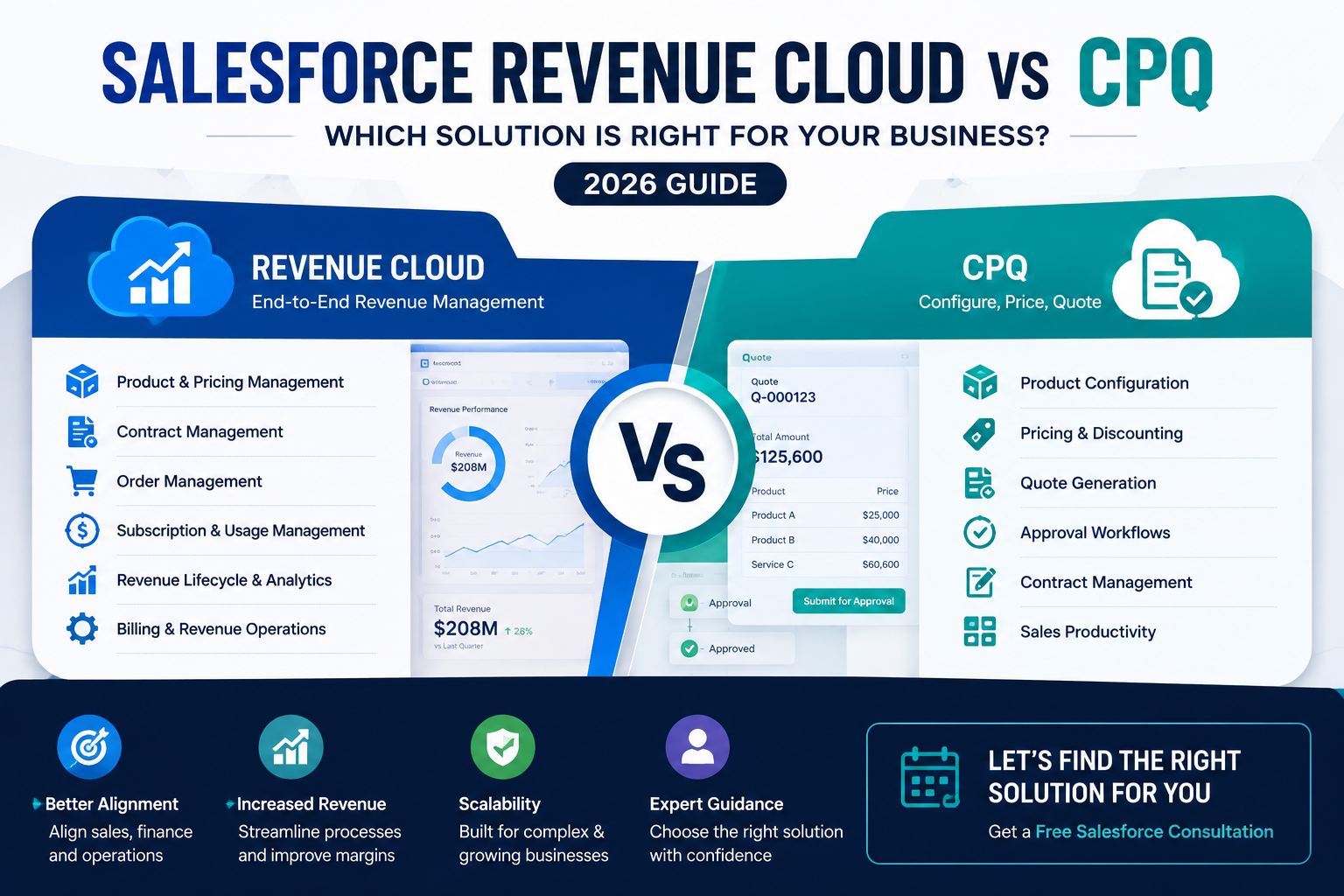

Choosing the right Salesforce revenue management solution can be challenging, especially for businesses comparing Salesforce Revenue Cloud vs CPQ.
Both solutions can help organizations improve product configuration, pricing, quoting, and revenue processes. However, they are designed for different levels of business complexity and revenue operations.
For some companies, Salesforce CPQ may still be the right choice. For organizations looking to modernize broader revenue processes, Salesforce Revenue Cloud may provide a more comprehensive approach.
The important question isn’t simply:
“Which Salesforce product is better?”
The better question is:
“Which solution fits our current business processes, technology environment, and future growth plans?”
In this guide, we’ll compare Salesforce Revenue Cloud and Salesforce CPQ across functionality, implementation, pricing considerations, integrations, scalability, and use cases so business and technology leaders can make a more informed decision.
Salesforce Revenue Cloud vs CPQ: Quick Comparison
| Feature | Salesforce Revenue Cloud | Salesforce CPQ |
|---|---|---|
| Product Configuration | ✅ | ✅ |
| Pricing Management | ✅ | ✅ |
| Quote Generation | ✅ | ✅ |
| Complex Pricing | ✅ | ✅ |
| Contract Management | ✅ | Limited / depends on setup |
| Order Management | ✅ | Depends on architecture |
| Billing & Revenue Processes | Broader capabilities | More focused |
| Revenue Lifecycle | Broader | Primarily CPQ-focused |
| Salesforce CRM Integration | ✅ | ✅ |
| Best For | Complex end-to-end revenue operations | Configure, Price, Quote |
| Long-Term Expansion | Strong | Depends on existing architecture |
| Implementation Complexity | Higher | Moderate to High |
Important: Capabilities and product packaging can change as Salesforce evolves its platform, so businesses should evaluate their current Salesforce edition, existing architecture, licenses, and specific requirements before selecting a solution.
What Is Salesforce CPQ?
Salesforce CPQ, or Configure, Price, Quote, is designed to help sales teams automate complex product configuration, pricing, and quote generation.
CPQ is particularly useful when a business sells products or services with:
- Multiple configurations
- Complex pricing rules
- Discounts
- Product dependencies
- Bundles
- Approval requirements
- Contractual pricing
Instead of manually creating quotes in spreadsheets or disconnected systems, Salesforce CPQ brings the quoting process into the Salesforce ecosystem.
Typical Salesforce CPQ capabilities include:
- Product configuration
- Product bundles
- Pricing rules
- Discount management
- Quote generation
- Approval workflows
- Quote templates
- Contract-related processes
- Sales automation
For businesses whose primary challenge is configure → price → quote, CPQ can be a strong solution.
What Is Salesforce Revenue Cloud?
Salesforce Revenue Cloud takes a broader approach to revenue operations.
Rather than focusing primarily on the quoting stage, Revenue Cloud is designed to support more connected revenue processes across the customer lifecycle.
Depending on the organization’s requirements and Salesforce products in use, revenue processes can involve:
- Product management
- Pricing
- Configuration
- Quoting
- Contract processes
- Orders
- Billing
- Subscription models
- Usage-based models
- Revenue operations
This makes Revenue Cloud particularly relevant for organizations with more complex revenue models or businesses looking to connect multiple stages of their revenue lifecycle.
Salesforce Revenue Cloud vs CPQ: The Main Difference
The simplest way to understand the difference is:
Salesforce CPQ
Focuses primarily on Configure, Price, Quote.
Salesforce Revenue Cloud
Takes a broader revenue lifecycle approach.
For example, imagine a technology company selling:
- One-time products
- Subscription plans
- Usage-based services
- Add-ons
- Renewals
- Upgrades
A CPQ-focused architecture may solve the configuration and quoting requirements.
But as the business expands into more complex subscription, ordering, billing, and revenue processes, it may require a broader revenue management architecture.
Revenue Cloud vs CPQ: Which Businesses Need Which?
There is no universal answer.
Salesforce CPQ May Be Suitable If:
Your organization primarily needs:
- Complex product configuration
- Advanced pricing
- Discount automation
- Quote generation
- Approval workflows
- Sales process automation
CPQ can be particularly effective when your existing Salesforce architecture already handles downstream processes effectively.
Revenue Cloud May Be More Suitable If:
Your business needs to connect broader revenue processes, such as:
- Complex product and pricing models
- Subscription revenue
- Usage-based pricing
- Order lifecycle management
- Contract processes
- Revenue operations
- Multiple revenue models
- Broader automation
Revenue Cloud may also be worth evaluating when your organization is planning significant revenue-process modernization.
Salesforce Revenue Cloud vs CPQ: Pricing Considerations
The software license is only one component of the overall investment.
Businesses should also consider:
- Implementation
- Data migration
- Customization
- Integration
- User training
- Testing
- Change management
- Ongoing Salesforce consulting
- Managed services
A smaller CPQ project may have a lower initial implementation requirement than a broader Revenue Cloud transformation.
However, selecting a solution based only on initial cost can be misleading.
Consider Total Cost of Ownership
Ask:
Will this architecture continue to support our business as our products, pricing models, customers, and revenue processes become more complex?
A solution that appears cheaper initially may require additional customization or integrations later.
Salesforce CPQ vs Revenue Cloud: Implementation Complexity
Implementation complexity depends heavily on your current Salesforce environment.
CPQ Implementation
A CPQ implementation may involve:
- Product catalog setup
- Product bundles
- Pricing rules
- Discount logic
- Quote templates
- Approval workflows
- User configuration
- Testing
- Deployment
Revenue Cloud Implementation
A broader Revenue Cloud implementation can involve:
- Business process discovery
- Product and catalog architecture
- Pricing strategy
- Configuration
- Quoting
- Contract processes
- Order management
- Billing/revenue processes
- Data migration
- Integrations
- Testing
- User training
- Deployment
- Post-launch optimization
Because the scope can be broader, Revenue Cloud implementations may require more planning and architectural expertise.
When Should You Consider Moving Beyond CPQ?
You don’t necessarily need to replace CPQ simply because Revenue Cloud exists.
However, it may be worth evaluating your architecture when you experience problems such as:
1. Increasingly Complex Revenue Models
Your business now offers subscriptions, usage-based pricing, renewals, upgrades, or multiple revenue models.
2. Disconnected Revenue Processes
Sales, contracts, orders, billing, and revenue operations rely on separate systems with limited connectivity.
3. Manual Processes
Employees spend significant time moving data between systems or manually managing pricing and orders.
4. Integration Complexity
Your Salesforce environment requires numerous custom integrations to connect revenue-related processes.
5. Scalability Issues
Your current architecture is becoming difficult to maintain as products, customers, and transactions increase.
6. Poor Visibility
Leadership cannot easily track the customer journey from opportunity and quote through order and revenue processes.
These are signs that a broader revenue architecture assessment may be worthwhile.
Revenue Cloud vs CPQ: A Practical Decision Framework
Use the following framework when evaluating your options.
| Business Requirement | Recommended Direction |
|---|---|
| Basic product configuration | CPQ may be sufficient |
| Complex product bundles | CPQ / Revenue Cloud |
| Advanced pricing | CPQ / Revenue Cloud |
| Complex quote approvals | CPQ / Revenue Cloud |
| Subscription business model | Evaluate Revenue Cloud |
| Usage-based pricing | Evaluate Revenue Cloud |
| Complex order lifecycle | Revenue Cloud |
| Broader revenue transformation | Revenue Cloud |
| Existing stable CPQ environment | Optimize before replacing |
| Major CRM modernization | Evaluate broader Revenue Cloud architecture |
The correct decision depends on your existing Salesforce environment rather than simply choosing the newest technology.
Don’t Replace CPQ Without an Assessment
One of the biggest mistakes organizations can make is assuming they should immediately migrate from Salesforce CPQ to Revenue Cloud.
Before making a decision, evaluate:
- Existing CPQ configuration
- Custom Apex and Lightning components
- Integrations
- Product catalog
- Pricing architecture
- Historical data
- Contracts
- Order processes
- User workflows
- Business requirements
- Future revenue strategy
A Salesforce consultant can help determine whether your organization should:
Optimize the existing CPQ environment → Modernize selectively → or plan a broader Revenue Cloud transformation.
How a Salesforce Consulting Partner Can Help
Choosing between Revenue Cloud and CPQ is not purely a technology decision.
It is a business architecture decision.
An experienced Salesforce consulting partner can assess:
- Current Salesforce architecture
- Business processes
- Revenue model
- Product catalog
- Pricing complexity
- Integration requirements
- Data architecture
- Future scalability
- Implementation roadmap
The goal should be to select an architecture that solves today’s problems without creating unnecessary complexity tomorrow.
Why Choose ApplikonTech?
ApplikonTech helps businesses across the USA, UK, and Canada evaluate, implement, integrate, and optimize Salesforce solutions.
Our Salesforce consulting capabilities include:
- Salesforce Revenue Cloud Consulting
- Salesforce CPQ Consulting
- Revenue Cloud Implementation
- Salesforce CPQ Implementation
- Sales Cloud
- Service Cloud
- Data Cloud
- Experience Cloud
- Salesforce Integration
- Data Migration
- Salesforce Managed Services
- CRM Optimization
If you’re unsure whether Salesforce Revenue Cloud or CPQ is right for your organization, our consultants can evaluate your current Salesforce environment and business requirements before recommending an implementation strategy.
Frequently Asked Questions
Is Salesforce Revenue Cloud replacing Salesforce CPQ?
Not every organization needs to replace CPQ. The right approach depends on your existing architecture, business requirements, Salesforce products, and future revenue strategy.
Is Revenue Cloud better than Salesforce CPQ?
Neither solution is universally better. CPQ can be highly effective for configure, price, and quote requirements, while Revenue Cloud can be more appropriate for organizations seeking broader revenue process capabilities.
Should I migrate from Salesforce CPQ to Revenue Cloud?
Not automatically. First evaluate your existing CPQ implementation, customizations, integrations, data, and business requirements. A Salesforce consulting assessment can help determine whether migration is justified.
How much does Revenue Cloud implementation cost?
Implementation costs vary based on business complexity, integrations, data migration, customization, number of users, and project scope. A detailed discovery process is normally required before providing an accurate estimate.
Can Salesforce consultants help compare Revenue Cloud and CPQ?
Yes. A Salesforce consulting partner can assess your current architecture, revenue processes, technical requirements, and future roadmap to determine which approach is most appropriate.
Final Verdict: Salesforce Revenue Cloud vs CPQ
The decision isn’t simply about choosing the newest Salesforce product.
Choose CPQ when:
Your primary requirement is configure, price, quote, and your existing revenue architecture effectively supports downstream processes.
Consider Revenue Cloud when:
Your organization needs a broader approach to product, pricing, quoting, ordering, subscriptions, usage, contracts, billing, and revenue operations.
For organizations with an existing CPQ environment, the smartest approach is to assess the current architecture before deciding whether to optimize, modernize, or migrate.
Planning Your Salesforce Revenue Strategy?
Not sure whether your organization should continue with Salesforce CPQ or evaluate Salesforce Revenue Cloud?
Get a Free Salesforce Revenue Cloud & CPQ Assessment
ApplikonTech can evaluate your current Salesforce architecture, business processes, pricing model, integrations, and future requirements and help you develop a practical roadmap.
→ Talk to a Salesforce Revenue Cloud Consultant