

Salesforce Revenue Cloud helps businesses manage complex revenue processes across products, pricing, quoting, contracts, subscriptions, and the broader quote-to-cash lifecycle. However, getting value from the platform depends heavily on how well it is implemented.
A successful Salesforce Revenue Cloud implementation requires more than configuring features. Businesses need to align their existing revenue processes with the platform, migrate data, integrate other systems, configure pricing and product structures, and prepare users for adoption. Understanding the implementation process, costs, and partner selection criteria can help businesses plan the project more effectively.
What Is Salesforce Revenue Cloud Implementation?
Salesforce Revenue Cloud implementation involves configuring the platform according to a company’s specific sales and revenue requirements. The scope can include product catalog management, pricing procedures, quoting, contracts, subscriptions, billing-related processes, integrations, and revenue lifecycle workflows.
Unlike a simple software deployment, Revenue Cloud implementation often requires changes to existing business processes. An experienced Salesforce Revenue Cloud consulting team can analyze these processes, identify gaps, design the required solution, and configure the platform accordingly.
The objective is to create a scalable revenue management environment that reduces manual work and supports more consistent processes.
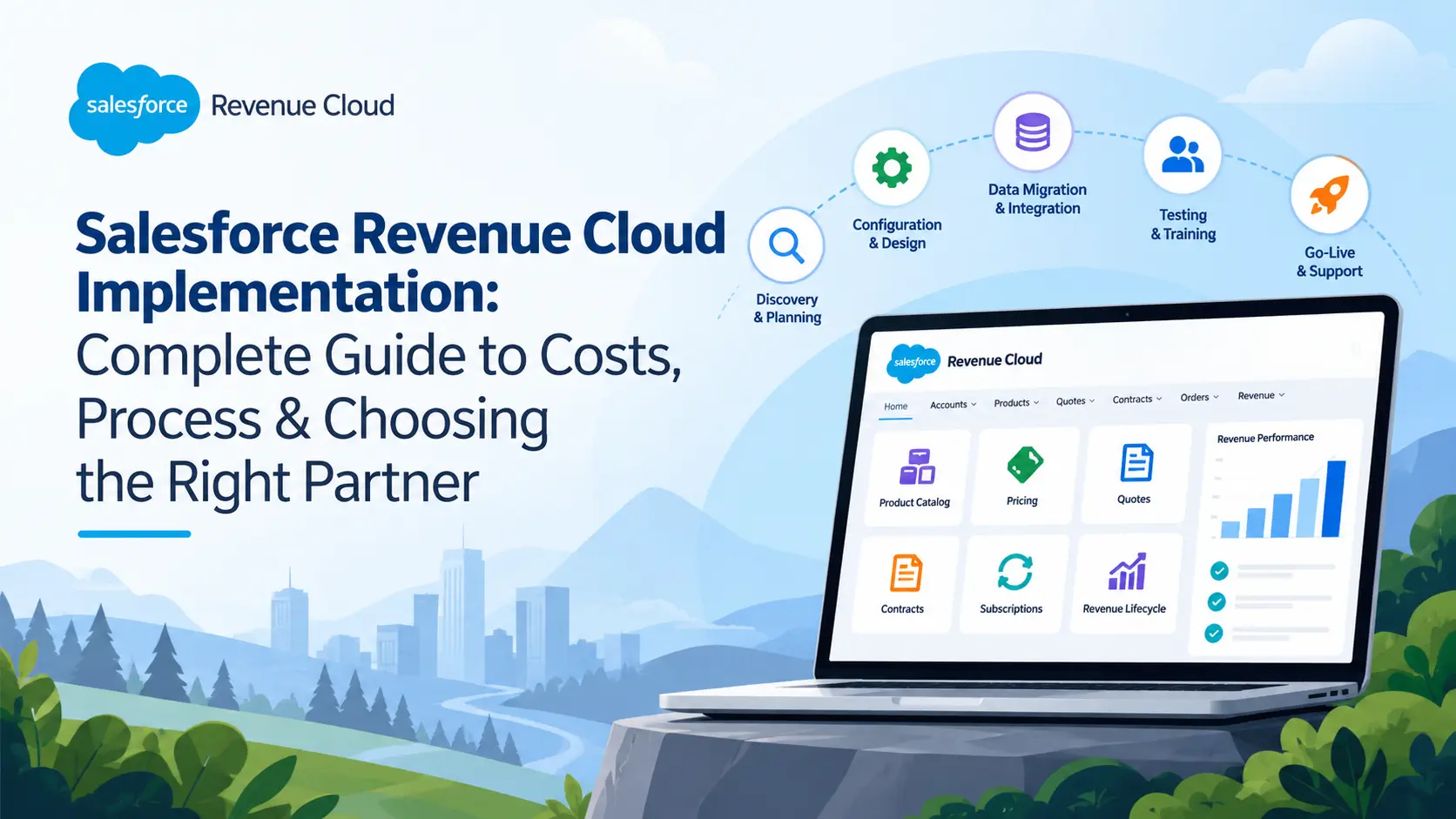
Salesforce Revenue Cloud Implementation Process
A structured implementation process helps reduce technical issues and ensures that the platform aligns with business objectives.
1. Business and Requirements Discovery
The project typically starts with understanding the company’s existing sales and revenue processes. This includes reviewing product structures, pricing models, quoting workflows, contracts, subscriptions, approvals, and downstream systems.
The implementation team identifies business requirements, process gaps, integration needs, and opportunities for automation.
2. Solution Design and Configuration
Once requirements are established, the implementation team designs the Revenue Cloud architecture and begins configuration.
Depending on the business model, this may include:
- Product catalog configuration
- Pricing procedures and pricing rules
- Quote configuration
- Approval workflows
- Contract and subscription processes
- Revenue lifecycle workflows
The goal is to configure the platform around the business rather than introducing unnecessary customization.
3. Data Migration and Integrations
Existing customer, product, pricing, and transactional data may need to be migrated into the new environment.
Revenue Cloud may also need to integrate with systems such as ERP, CRM, billing, finance, or other business applications. Proper integration planning is essential to ensure that data can move reliably between systems.
4. Testing and User Training
Before deployment, the configured solution should undergo functional testing and user acceptance testing.
Testing can help identify problems with pricing, product configuration, approvals, integrations, and other workflows.
User training is equally important. Employees need to understand how their daily processes will work in the new system.
5. Deployment and Post-Launch Support
After testing and approval, the solution can be deployed to the production environment.
Post-launch support helps identify configuration issues, address user concerns, monitor integrations, and optimize processes based on real-world usage.
How Much Does Salesforce Revenue Cloud Implementation Cost?
There is no single fixed price for Salesforce Revenue Cloud implementation because the total investment depends on the scope and complexity of the project.
Important cost factors include:
- Number of users and business teams
- Product and pricing complexity
- Data migration requirements
- Third-party integrations
- Customization and automation
- Existing Salesforce architecture
- Testing and training requirements
- Post-implementation support
A straightforward implementation may require significantly less effort than a complex enterprise deployment involving multiple systems, countries, pricing models, and revenue processes.
Businesses should therefore evaluate implementation costs based on the complete project scope rather than comparing partners solely on their initial quoted price.
How to Choose the Right Salesforce Revenue Cloud Implementation Partner
Selecting the right Salesforce Revenue Cloud implementation partner can have a significant impact on the project’s outcome.
Look for a partner that can demonstrate:
- Relevant Salesforce Revenue Cloud expertise
- Experience with complex pricing and product models
- Understanding of CPQ and quote-to-cash processes
- Data migration capabilities
- Integration expertise
- A structured implementation methodology
- Transparent project communication
- Post-launch support and optimization
It is also useful to review relevant case studies and discuss your business requirements before finalizing a partner. A good implementation partner should be able to explain not only what they will configure but also why a particular approach is appropriate for your business.
Why Professional Revenue Cloud Implementation Matters
A well-planned implementation can help businesses create more efficient revenue operations, improve pricing consistency, reduce manual processes, and provide better visibility across the revenue lifecycle.
More importantly, a scalable implementation can support future business growth without requiring the organization to redesign its entire revenue architecture every time its products, pricing models, or sales processes change.
Conclusion
Salesforce Revenue Cloud implementation is a strategic project that involves much more than platform configuration. From requirements discovery and solution design to data migration, integrations, testing, and post-launch optimization, every stage can influence the final outcome.
If your organization is planning a Revenue Cloud project, working with an experienced implementation and consulting partner can help you build a solution aligned with your business requirements and long-term revenue goals.
Looking for Salesforce Revenue Cloud implementation services? Contact Applikon IT Solutions to discuss your requirements, implementation scope, and business objectives.