
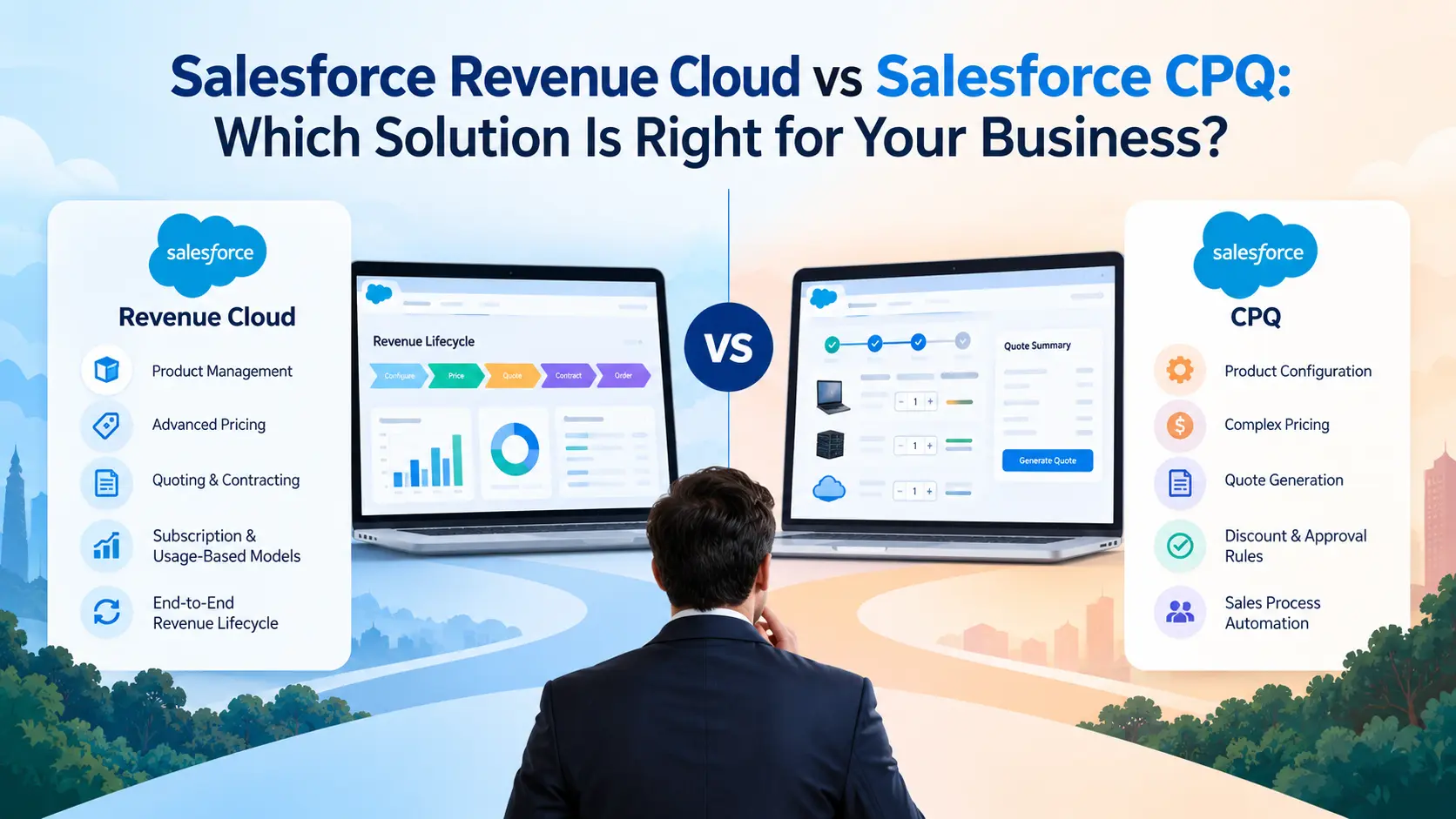

Businesses using Salesforce often reach a point where their existing quoting and revenue processes need to become more flexible, scalable, and connected. This is where the comparison between Salesforce Revenue Cloud vs Salesforce CPQ becomes important.
While Salesforce CPQ has traditionally helped businesses configure products, calculate pricing, and generate accurate quotes, Salesforce Revenue Cloud takes a broader approach to managing revenue processes across the customer lifecycle.
So, which solution is right for your business? The answer depends on your products, pricing model, sales processes, existing Salesforce environment, and long-term revenue strategy.
What Is Salesforce Revenue Cloud?
Salesforce Revenue Cloud is designed to support broader revenue lifecycle processes, connecting areas such as product management, pricing, quoting, contracting, ordering, and other revenue-related operations within the Salesforce ecosystem.
It can be particularly relevant for businesses with complex product portfolios, subscription models, usage-based pricing, or multiple revenue streams.
Instead of focusing only on the quoting stage, Revenue Cloud can help organizations build a more connected approach to revenue management.
What Is Salesforce CPQ?
Salesforce CPQ (Configure, Price, Quote) is designed to help sales teams manage complex product configurations, pricing rules, discounts, and quote generation.
Salesforce CPQ can be valuable for organizations selling products or services with complicated configurations and pricing structures. It helps sales representatives create accurate quotes while applying predefined business rules.
For businesses whose primary requirement is sophisticated configuration, pricing, and quoting, CPQ can remain an important part of their Salesforce architecture.
Salesforce Revenue Cloud vs Salesforce CPQ: Key Differences
Although both solutions address complex revenue processes, their scope and use cases can differ.
| Area | Salesforce Revenue Cloud | Salesforce CPQ |
|---|---|---|
| Primary focus | Broader revenue lifecycle management | Configure, price, and quote |
| Product management | Supports broader product and revenue processes | Strong product configuration capabilities |
| Pricing | Supports complex and modern pricing models | Advanced CPQ pricing and discounting |
| Subscription models | Designed for broader revenue scenarios | Primarily focused on CPQ processes |
| Usage-based models | Suitable for consumption-based business models | May require additional configuration |
| Revenue processes | Broader end-to-end approach | Primarily focused on sales and quoting |
| Best suited for | Businesses modernizing revenue operations | Businesses focused on complex quoting |
The choice should therefore be based on business requirements rather than simply selecting the newer or broader platform.
When Should You Choose Salesforce Revenue Cloud?
Salesforce Revenue Cloud implementation can make sense for organizations looking beyond traditional CPQ functionality and wanting to modernize their revenue processes.
It may be worth evaluating Revenue Cloud if your business has:
- Subscription or usage-based pricing models
- Multiple product and revenue streams
- Complex pricing structures
- Evolving product catalogs
- Requirements extending beyond quoting
- A need to connect different revenue processes within Salesforce
Businesses planning a Revenue Cloud implementation should first evaluate their current Salesforce architecture, integrations, data model, and business processes. Proper planning can help reduce implementation challenges and support future scalability.
When Is Salesforce CPQ Still the Right Choice?
Salesforce CPQ can continue to be suitable for businesses that primarily need advanced configuration, pricing, and quoting capabilities.
It may be appropriate when your organization:
- Already has a mature Salesforce CPQ environment
- Relies heavily on complex product configurations
- Has established CPQ workflows and integrations
- Primarily needs to improve quoting and sales processes
- Does not currently require broader revenue lifecycle capabilities
For organizations with an existing CPQ investment, the decision should also consider migration requirements, existing customizations, integrations, and the potential impact on sales operations.
Revenue Cloud vs CPQ: How Should You Decide?
When comparing Salesforce CPQ vs Revenue Cloud, consider more than individual features. Start by evaluating your current and future business requirements.
Consider factors such as:
- Product complexity: How complex are your products and configurations?
- Pricing model: Do you use subscriptions, usage-based pricing, recurring revenue, or traditional pricing?
- Revenue processes: Do you only need quoting, or do you need broader revenue lifecycle capabilities?
- Existing Salesforce architecture: What CPQ, CRM, integrations, and customizations are already in place?
- Future scalability: Will your revenue model become more complex as your business grows?
- Implementation requirements: What resources, timeline, integrations, and budget will be required?
A detailed assessment of these areas can help businesses identify the solution that aligns with their operational requirements.
Need Help Choosing Between Salesforce Revenue Cloud and CPQ?
Choosing between Salesforce Revenue Cloud and Salesforce CPQ requires a clear understanding of your business processes, Salesforce environment, product structure, and revenue model.
If you’re evaluating Salesforce Revenue Cloud implementation or considering how it compares with your existing CPQ setup, Applikon can help assess your requirements and develop an implementation approach aligned with your business goals.
Talk to a Salesforce Revenue Cloud expert to discuss your requirements and explore the right approach for your organization.