
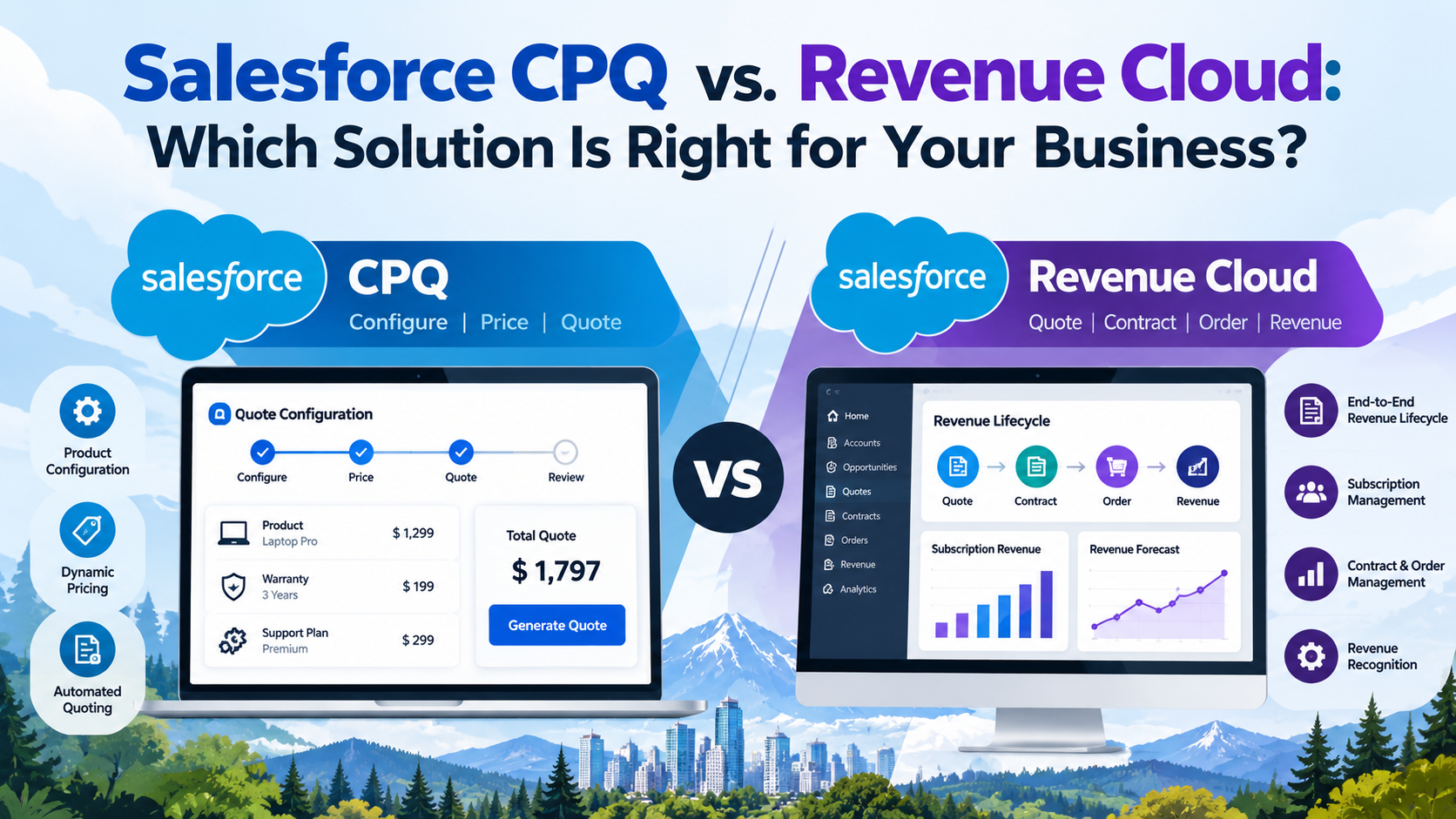

Businesses that rely on Salesforce to manage sales and revenue operations need efficient ways to configure products, calculate prices, generate quotes, and manage customer orders. However, as pricing models become more complex, traditional quoting processes may no longer meet every business requirement.
This is where Salesforce CPQ and Revenue Cloud come into the picture. While both support revenue operations, they differ in architecture, capabilities, and scope. Understanding these differences can help businesses choose the right solution, plan future improvements, and determine whether a new Salesforce Revenue Cloud implementation makes sense for their organization.
What Is Salesforce CPQ?
Salesforce CPQ stands for Configure, Price, Quote. It helps sales teams create accurate quotes by automating product selection, pricing calculations, discount rules, and approval workflows.
Salesforce CPQ is particularly useful for businesses selling products with multiple configurations, bundles, pricing conditions, or contract terms. Instead of relying on spreadsheets and manual calculations, sales representatives can follow standardized rules to prepare quotes more efficiently.
Businesses with an established CPQ setup may benefit from optimization, integration improvements, and workflow enhancements rather than immediately replacing their existing system. Professional Salesforce CPQ services can help identify performance gaps and improve the quoting process.
What Is Salesforce Revenue Cloud?
Salesforce Revenue Cloud supports a broader approach to managing revenue operations, extending beyond product configuration and quote generation.
Salesforce currently refers to its newer platform as Revenue Management (formerly Revenue Cloud). This native Salesforce platform supports capabilities across the revenue lifecycle, including product catalog management, pricing, quoting, order management, and billing-related processes.
It can help organizations connect different stages of the customer purchasing journey and support more complex business models, including subscriptions and consumption-based pricing.
For companies planning to modernize their revenue operations, Salesforce Revenue Cloud services USA can include requirements assessment, solution design, implementation, integrations, and migration planning.
Salesforce CPQ vs. Revenue Cloud: Key Differences
Although both solutions support quoting and pricing, their underlying architectures and broader capabilities differ.
| Feature | Salesforce CPQ | Revenue Management |
|---|---|---|
| Primary focus | Product configuration, pricing, and quoting | Broader revenue lifecycle management |
| Architecture | Managed package | Native Salesforce platform |
| Product catalog | Established CPQ product and bundle model | Modern product catalog and configuration capabilities |
| Pricing | Pricing rules and discount automation | Flexible pricing procedures and pricing models |
| Revenue processes | Primarily quoting and related workflows | Broader quoting, ordering, and billing capabilities |
| Best suited for | Businesses with established CPQ processes | Businesses seeking broader revenue modernization |
The right choice depends on your current Salesforce environment, operational complexity, and future business goals. Revenue Management is not simply a renamed version of the legacy Salesforce CPQ managed package.
Which Solution Is Right for Your Business?
Choosing between Salesforce CPQ and Revenue Management requires an assessment of your business requirements rather than a decision based only on features.
When Salesforce CPQ May Be the Right Choice
Consider retaining and optimizing Salesforce CPQ if:
- Your existing quoting workflows meet your business requirements.
- Your product catalog and pricing rules are already well established.
- You need targeted improvements to approvals, integrations, or quote accuracy.
- A migration would introduce unnecessary costs or operational disruption.
In these situations, experienced Salesforce consultants can help improve the existing implementation while identifying areas that may require future modernization.
When Revenue Management May Be a Better Fit
Consider Revenue Management if your business:
- Needs connected processes across quoting, ordering, and billing.
- Uses complex subscription, usage-based, or hybrid pricing models.
- Plans to support additional sales channels or more sophisticated product offerings.
- Wants to modernize its Salesforce architecture for future growth.
A detailed requirements assessment can help determine whether the newer platform offers meaningful benefits over your existing setup.
What Should You Consider Before Migrating?
Moving from Salesforce CPQ to Revenue Management requires more than transferring records between systems. The products have different data models and architectural approaches, so migration planning is essential.
Before proceeding, evaluate the following areas:
- Product catalog: Review existing products, bundles, attributes, and configuration rules.
- Pricing logic: Identify discount structures, approval workflows, and custom pricing requirements.
- Data migration: Determine which contracts, subscriptions, assets, and transaction records need to be migrated.
- Integrations: Assess dependencies involving ERP, billing, finance, and other business systems.
- Testing and adoption: Plan user training, reporting validation, testing, and rollout activities.
Working with a qualified Salesforce Revenue Cloud consultant USA can help your team evaluate technical dependencies, compare migration strategies, and establish a realistic implementation plan.
Not every organization needs an immediate migration. The right approach depends on system complexity, business priorities, licensing, budget, and long-term requirements.
Why Choose a Salesforce Implementation Partner?
Selecting the right implementation partner can make a significant difference to the success of your Salesforce project. Beyond technical configuration, businesses need support with requirements gathering, solution architecture, data management, integrations, testing, and user adoption.
ApplikonTech helps businesses evaluate Salesforce solutions and identify implementation approaches aligned with their operational needs. Whether you want to improve an existing CPQ environment or explore Revenue Management, a structured assessment can help clarify the scope, priorities, and next steps.
Final Thoughts: CPQ or Revenue Cloud?
Salesforce CPQ may remain suitable for businesses with effective, established quoting processes, while Revenue Management may be a better fit for organizations seeking broader revenue lifecycle capabilities.
The best decision starts with understanding your current limitations and future goals.
Ready to evaluate your Salesforce setup? Contact ApplikonTech to discuss your requirements, assess your implementation options, and plan the right approach for your business.