

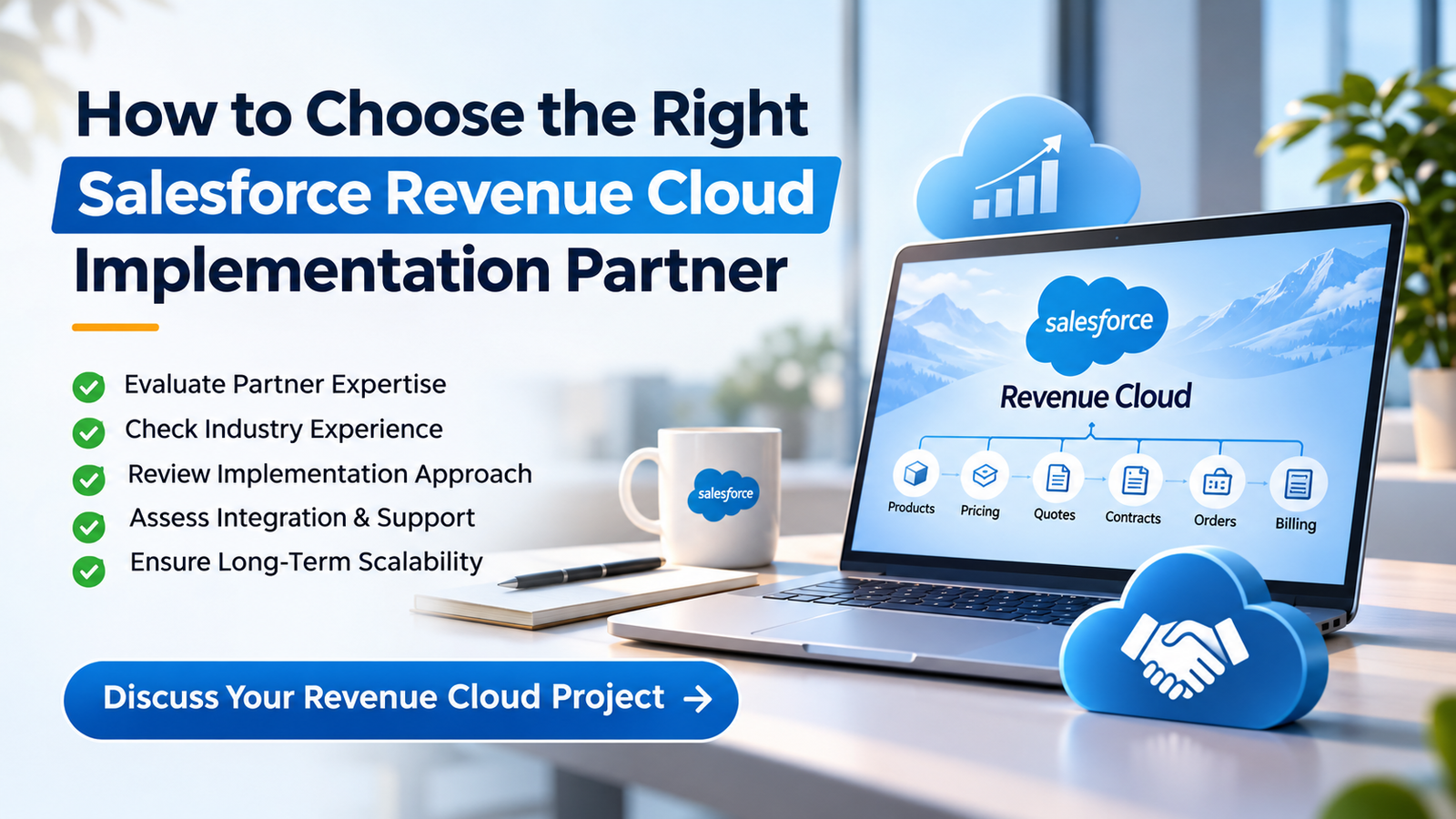
Businesses with complex pricing models, subscription services, and multiple sales channels need more than a traditional CRM to manage their revenue operations. They need connected processes that help manage products, pricing, quotes, contracts, orders, and billing.
Salesforce Revenue Cloud helps businesses bring these revenue-related processes together within the Salesforce ecosystem. However, implementing it successfully requires careful planning, technical expertise, and a clear understanding of business requirements.
Choosing the right Salesforce Revenue Cloud implementation partner is therefore an important decision. The right consulting partner can help your organization evaluate its existing systems, design an appropriate solution, manage integrations, and build scalable revenue workflows.
But how do you identify a partner with the right experience?
In this guide, we explain the key factors to evaluate, important questions to ask, common implementation mistakes to avoid, and how to select a Salesforce consulting partner that fits your business needs.
What Is Salesforce Revenue Cloud?
Salesforce Revenue Cloud is a collection of Salesforce capabilities designed to support revenue-related business processes, including product configuration, pricing, quoting, contract management, and order management.
It helps businesses connect different stages of the revenue lifecycle and reduce disconnected processes between sales, finance, and operations.
Depending on the products and capabilities licensed, organizations may use Revenue Cloud to support:
- Product Catalog Management: Organize products, product bundles, and related information.
- Pricing Management: Configure pricing rules, discounts, and business-specific pricing structures.
- Configure, Price, Quote (CPQ): Help sales teams configure products and generate accurate quotes.
- Contract Management: Manage contract-related workflows and information.
- Order Management: Coordinate order creation and downstream processes.
- Subscription Management: Support recurring revenue and subscription-related workflows.
- Billing Processes: Connect relevant revenue and billing operations.
The exact capabilities available depend on the Salesforce products, edition, licenses, and implementation architecture selected.
Why Does Your Business Need a Salesforce Revenue Cloud Implementation Partner?
Revenue operations often involve multiple departments, applications, and business rules. Implementing a revenue platform without understanding these dependencies can create unnecessary complexity.
An experienced implementation partner can help businesses address several challenges.
1. Complex Product and Pricing Structures
Businesses selling configurable products, bundled services, or subscription packages may have complicated pricing requirements.
A consulting partner can evaluate these requirements and help design appropriate product catalogs, pricing rules, and configuration workflows.
2. Manual Quoting Processes
When sales teams create quotes manually, errors and delays can affect the customer experience.
A properly configured Salesforce environment can help standardize quote creation, automate calculations, and support approval workflows.
3. Disconnected Revenue Operations
Product information, customer records, contracts, and billing data may exist across different applications.
A Revenue Cloud implementation partner can evaluate how these systems should communicate and identify suitable integration approaches.
4. Limited Revenue Visibility
Disconnected processes can make it difficult for management teams to understand the status of opportunities, quotes, contracts, and orders.
A connected revenue workflow can improve visibility and reporting when supported by reliable data and appropriate configuration.
5. Difficulty Scaling Business Operations
As a company grows, its product catalog, pricing models, customer segments, and sales processes may become more complex.
A scalable implementation can help businesses accommodate these changes without constantly rebuilding their CRM environment.
10 Factors to Consider When Choosing a Salesforce Revenue Cloud Implementation Partner
Selecting a consulting partner should involve more than comparing quotations. Evaluate their technical capabilities, project experience, implementation methodology, and ability to understand your business.
1. Experience With Salesforce Revenue Cloud
Start by evaluating the partner’s experience with Revenue Cloud and related Salesforce technologies.
Ask whether the team has worked on projects involving:
- Product catalog configuration
- Complex pricing structures
- Product bundles and configuration
- Quote generation and approval workflows
- Contract and order management
- Subscription and recurring revenue processes
- Revenue-related integrations
A partner should be able to explain how its experience relates to your specific requirements.
2. Understanding of Your Business Model
Every business has a different revenue model.
For example, a SaaS company may require subscription and recurring revenue workflows, while a manufacturing business may need product configuration, complex pricing, and order management.
Your implementation partner should understand:
- How your products and services are sold.
- How pricing and discounts are calculated.
- How quotes are approved.
- How contracts are created and managed.
- How orders move through your business.
- Which departments are involved in revenue operations.
A partner that understands your business processes can recommend a more relevant solution.
3. Qualified Salesforce Consultants
Review the technical qualifications of the team assigned to your project.
Relevant Salesforce certifications can demonstrate platform knowledge, but certifications alone do not guarantee implementation success.
Evaluate practical experience in areas such as Salesforce architecture, CPQ, Revenue Cloud, integrations, automation, and data management.
Ask which consultants will actually work on your project and what responsibilities they will handle.
4. Integration Capabilities
Revenue operations rarely work in isolation.
Your organization may need to connect Salesforce with ERP systems, accounting software, payment platforms, e-commerce applications, or internal business tools.
Before selecting a partner, ask:
- Which integration technologies do they support?
- Can they work with REST and SOAP APIs where appropriate?
- How will data synchronization be managed?
- How will integration failures be monitored?
- What security and access controls will be implemented?
A good implementation plan should document integration requirements, dependencies, testing, and maintenance responsibilities.
5. Data Migration Expertise
Moving existing product, customer, pricing, contract, and transaction data requires careful planning.
Your consulting partner should have a structured data migration process involving:
- Data source identification.
- Data quality assessment.
- Field mapping.
- Duplicate identification and cleansing.
- Test migration.
- Data validation.
- Final migration and verification.
Ask how the partner will preserve important relationships between records and validate migrated information.
6. Clear Implementation Methodology
A reliable Salesforce Revenue Cloud implementation partner should provide a documented project approach.
A typical implementation may include:
- Discovery and requirement analysis.
- Solution architecture and planning.
- Product and pricing configuration.
- Workflow and automation development.
- Integration and data migration.
- Testing and user acceptance.
- Deployment and training.
- Post-implementation support.
Ask for a project roadmap with milestones, deliverables, dependencies, and responsibilities.
7. Transparent Pricing and Scope
Implementation costs depend on project complexity, customization, integrations, data migration, and the number of business processes involved.
A professional consulting partner should clearly explain:
- What is included in the project.
- What is excluded.
- Which resources will be assigned.
- How additional requirements will be handled.
- Whether testing and training are included.
- What post-launch support costs.
Avoid choosing a partner based only on the lowest quotation. Compare proposals using the same requirements and deliverables.
8. Testing and Quality Assurance
Revenue-related systems need reliable calculations, pricing rules, and workflows.
Incorrect configurations can create problems with quotes, approvals, orders, and downstream processes.
Your partner should define testing procedures for:
- Product configuration.
- Pricing calculations.
- Discount rules.
- Quote generation.
- Approval workflows.
- Contract and order processes.
- Integrations.
- User permissions and access.
User acceptance testing should involve the employees who will use the system after deployment.
9. Post-Implementation Support
Your relationship with a Salesforce consulting partner should not necessarily end after deployment.
As business requirements evolve, you may need new pricing rules, workflow changes, integrations, reports, or technical support.
Ask whether the partner provides:
- Salesforce administration.
- Technical troubleshooting.
- Workflow optimization.
- System enhancements.
- Integration maintenance.
- User support.
- Ongoing consulting.
A clear support arrangement helps businesses plan for long-term CRM operations.
10. Communication and Project Management
Technical expertise is important, but effective communication is equally essential.
Your consulting partner should provide regular project updates, maintain documentation, communicate risks, and explain technical decisions in business terms.
Before signing an agreement, understand who will manage the project, how progress will be reported, and how issues will be escalated.
Salesforce Revenue Cloud Implementation Process
Understanding the implementation process helps businesses evaluate whether a consulting partner has a realistic approach.
Step 1: Business Discovery
The first stage focuses on understanding your revenue operations, business objectives, existing Salesforce environment, and technical requirements.
The team should identify current challenges and document the expected project outcomes.
Step 2: Solution Architecture
Based on the discovery process, the consulting team develops a solution design.
This may include product structures, pricing models, quote workflows, integrations, data architecture, and user access requirements.
Step 3: Configuration and Customization
The implementation team configures the relevant Salesforce capabilities according to the approved design.
This may involve product catalog setup, pricing configuration, automation, quote processes, and other revenue-related workflows.
Step 4: Data Migration and Integration
Relevant business data is prepared and migrated into the target environment.
Required third-party systems are integrated, and data flows are tested to ensure information moves correctly between applications.
Step 5: Testing and Validation
The implementation team validates configurations, pricing calculations, workflows, integrations, and user permissions.
Business stakeholders should participate in user acceptance testing before deployment.
Step 6: Deployment and User Training
After testing and approval, the solution is deployed according to the agreed release plan.
Employees receive appropriate training to understand the new workflows and use the system effectively.
Step 7: Ongoing Optimization
After launch, the organization can review system usage, identify process gaps, and prioritize improvements.
Ongoing support can help maintain the Salesforce environment as business requirements change.
Questions to Ask Before Hiring a Salesforce Revenue Cloud Consulting Partner
Before signing an implementation agreement, ask prospective partners these questions:
- What experience do you have with Salesforce Revenue Cloud projects?
- Have you worked with businesses that have similar pricing and revenue models?
- Which Salesforce products and capabilities do you recommend for our requirements?
- How will you evaluate our existing Salesforce environment?
- What is your approach to data migration?
- Which ERP and third-party integrations can you support?
- What implementation methodology do you follow?
- How will you test pricing rules and quote workflows?
- What is included in your implementation quotation?
- What support do you provide after deployment?
The answers should help you understand the partner’s technical capabilities and whether its working approach matches your expectations.
Common Mistakes to Avoid When Choosing an Implementation Partner
Businesses can reduce implementation risks by avoiding the following mistakes.
Choosing Based Only on Price
A low initial quotation may not include all the required services. Review the scope, deliverables, assumptions, and additional costs before making a decision.
Ignoring Business Requirements
Starting configuration before understanding the revenue model can result in workflows that do not match actual business operations.
Overlooking Integration Requirements
Revenue systems often depend on other business applications. Ignoring integrations during the planning stage can create additional complexity later.
Not Evaluating Technical Expertise
A general Salesforce CRM implementation background does not automatically demonstrate experience with complex revenue workflows.
Evaluate relevant project experience and technical knowledge.
Ignoring Post-Launch Support
Businesses should understand how future changes, troubleshooting, and enhancements will be handled.
Failing to Define Success Metrics
Before implementation begins, define measurable outcomes such as quote turnaround time, pricing accuracy, process efficiency, and user adoption.
Why Consider ApplikonTech for Salesforce Revenue Cloud Consulting?
Choosing a Salesforce consulting partner requires evaluating its technical capabilities, project approach, and understanding of your business requirements.
ApplikonTech provides Salesforce-related consulting and technical services, including implementation, integration, customization, and ongoing support.
For businesses evaluating a Revenue Cloud project, the discussion should begin with understanding:
- Your existing Salesforce environment.
- Product and pricing complexity.
- Current quoting and revenue workflows.
- Required integrations.
- Data migration requirements.
- Implementation priorities.
- Long-term support expectations.
This discovery process can help identify the right implementation scope and determine the next steps for your organization.
Rather than adopting a one-size-fits-all approach, businesses should evaluate Salesforce capabilities according to their actual revenue operations and technical requirements.
Discuss Your Revenue Cloud Project with ApplikonTech.
Share your current challenges and implementation requirements to explore a suitable consulting approach.
Frequently Asked Questions
1. What does a Salesforce Revenue Cloud implementation partner do?
A Salesforce Revenue Cloud implementation partner helps businesses assess requirements, design revenue workflows, configure Salesforce capabilities, manage integrations and data migration, test the solution, and support deployment.
2. How do I choose the right Salesforce Revenue Cloud implementation partner?
Evaluate the partner’s relevant Salesforce experience, understanding of your revenue model, technical capabilities, integration expertise, project methodology, pricing transparency, and ongoing support options.
3. What businesses need Salesforce Revenue Cloud?
Businesses with complex product catalogs, configurable offerings, subscription models, pricing structures, quoting requirements, or connected revenue operations may benefit from evaluating Revenue Cloud capabilities.
4. How long does Salesforce Revenue Cloud implementation take?
The timeline depends on the project scope, product complexity, integrations, data migration, customization, and testing requirements. A realistic estimate should be provided after a discovery and requirement assessment.
5. Can Salesforce Revenue Cloud integrate with ERP systems?
Integration possibilities depend on the ERP platform, available APIs, architecture, and business requirements. An implementation partner can assess the appropriate integration approach.
6. What affects Salesforce Revenue Cloud implementation costs?
Major cost factors include project complexity, licensing, product and pricing configuration, integrations, data migration, customization, testing, training, and post-launch support.
7. Can an existing Salesforce CPQ environment be evaluated?
Yes. Businesses can assess their existing CPQ configuration, pricing rules, product catalog, integrations, and business workflows before deciding whether optimization, migration, or a different solution is appropriate.
8. Does implementation include ongoing support?
Support arrangements vary by consulting partner and project agreement. Businesses should confirm whether administration, troubleshooting, optimization, and future enhancements are included or available separately.
Final Thoughts
Selecting the right Salesforce Revenue Cloud implementation partner is an important step toward building connected and scalable revenue operations.
The right partner should understand your business model, evaluate your technical requirements, provide a structured implementation roadmap, and support your organization beyond deployment.
Take time to compare consulting partners based on relevant experience, integration capabilities, project methodology, pricing transparency, and long-term support.
Planning a Salesforce Revenue Cloud implementation?
Connect with ApplikonTech to discuss your current Salesforce environment, revenue processes, and implementation requirements.