

INTRODUCTION
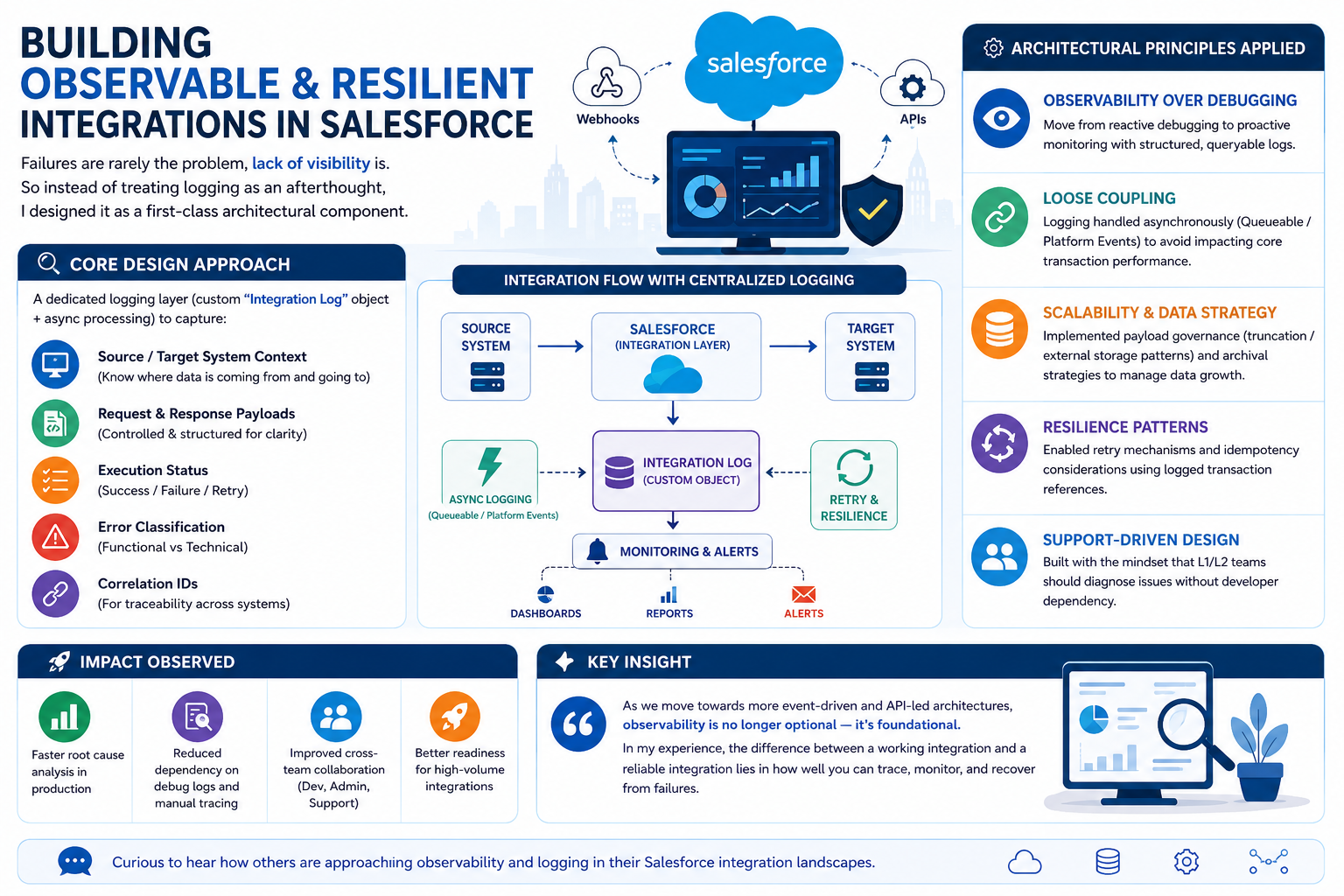
One pattern I’ve been consciously implementing across integrations is a centralized Integration Logging Framework within Salesforce. While working on webhook-driven and async integrations, I realized that failures are rarely the problem – lack of visibility is. So instead of treating logging as an afterthought, I designed it as a first-class architectural component. This shift in thinking has fundamentally changed how we approach integration reliability.
THE PROBLEM WE SOLVED
From Reactive Debugging to Proactive Monitoring
Traditional integration approaches often treat logging as a secondary concern. Developers debug failures reactively using platform debug logs, manual tracing through multiple systems, and time-consuming root cause analysis. This approach creates bottlenecks when issues occur in production.
The real insight came from recognizing that failures themselves aren’t the core issue – it’s the lack of visibility into what happened that makes resolution difficult. A properly instrumented integration can recover from many failures automatically.
CORE DESIGN APPROACH
Building a Dedicated Logging Layer
A dedicated logging layer (custom “Integration Log” object plus async processing) to capture:
What We Log:
- Source and Target System Context – Which systems are communicating and what transaction initiated the flow
- Request and Response Payloads – Complete structured data (controlled and truncated where necessary)
- Execution Status – Success, Failure, Retry, or Pending states with timestamps
- Error Classification – Distinguishing functional errors (data validation) from technical errors (connection failures)
- Correlation IDs – Unique identifiers for tracing a transaction across multiple systems and log entries
This comprehensive logging creates a queryable, structured record of every integration event.
ARCHITECTURAL PRINCIPLES
Five Core Principles That Drive the Design
Principle 1: Observability Over Debugging
Move from reactive debugging to proactive monitoring with structured, queryable logs. Instead of hunting through debug logs, you query your Integration Log object with SOQL to understand what happened.
Principle 2: Loose Coupling
Logging is handled asynchronously using Queueable jobs or Platform Events to avoid impacting core transaction performance. The main integration completes successfully while logging happens in parallel.
Principle 3: Scalability and Data Strategy
Implemented payload governance through truncation and external storage patterns. Large payloads are stored externally with references in logs. Archival strategies manage long-term data growth.
Principle 4: Resilience Patterns
Enabled retry mechanisms and idempotency using logged transaction references. If a transaction needs to retry, the log provides complete context for replay without data loss or duplication.
Principle 5: Support-Driven Design
Built with the mindset that L1/L2 support teams should diagnose issues without requiring developer intervention. Clear, structured logs enable self-service troubleshooting.
IMPLEMENTATION DETAILS
How We Structured the Solution
Custom Objects and Fields:
The Integration Log object captures:
- Integration Name (identifies which integration this is)
- External Transaction ID (correlation ID from external system)
- Source System
- Target System
- Request Payload (truncated or linked)
- Response Payload (truncated or linked)
- Status (Success, Failure, Retry)
- Error Type (Functional, Technical, Unknown)
- Error Message
- Execution Time (milliseconds)
- Retry Count
- Timestamp and CreatedBy
Async Processing:
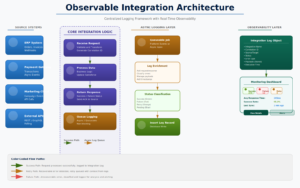
Integration logic publishes platform events or queues async jobs that create log records without blocking the main transaction. This ensures logging never impacts integration performance.
Payload Management:
Large payloads are stored separately using either ContentVersion (for document storage) or external storage systems, with references maintained in the log record.
IMPACT OBSERVED
Real-World Results
Faster Root Cause Analysis
What once took hours of investigation now takes minutes. Querying the Integration Log object directly provides complete context without jumping between systems.
Reduced Debug Log Dependency
Platform debug logs are no longer the primary investigation tool. Structured logs are more queryable and maintainable than raw debug output.
Improved Cross-Team Collaboration
Dev teams, System Admins, and L1/L2 Support teams can now collaborate on the same log records without requiring developers to extract and explain debug logs.
Better Readiness for High-Volume
Automated logging means integration performance is predictable even at scale. Async processing ensures high concurrency doesn’t degrade visibility.
Data-Driven Insights
With complete integration logs, you can analyze patterns, identify bottlenecks, and make data-driven improvements to integrations.
KEY ARCHITECTURAL PATTERNS
The Patterns That Make This Work
Pattern 1: Async-First Logging
Main transaction completes immediately. Logging happens via Queueable or Platform Events with a small delay tolerance.
Pattern 2: Correlation IDs
Every integration request gets a unique correlation ID passed through the entire flow for cross-system tracing.
Pattern 3: Error Classification
Not all errors are equal. Distinguishing functional errors (retry might not help) from technical errors (retry is beneficial) enables smarter recovery.
Pattern 4: Payload Governance
Large payloads are externalized, reducing Integration Log record storage while maintaining full traceability.
Pattern 5: Log Retention and Archival
Logs older than 90 days are archived to reduce query performance impact while maintaining historical reference.
KEY INSIGHT
Observability as a Foundation, Not an Afterthought
As we move towards more event-driven and API-led architectures, observability is no longer optional – it’s foundational. In my experience, the difference between a working integration and a reliable integration lies in how well you can trace, monitor, and recover from failures.
The cost of adding comprehensive logging upfront is far less than the cost of troubleshooting production failures without visibility. Modern integration architecture demands observability at every layer.
Final Thoughts
Building observable integrations requires intentional design from the start. The patterns outlined here – async logging, correlation tracking, error classification, and payload governance – create a foundation for integrations that can scale reliably.
The investment in a centralized logging framework pays dividends in reduced troubleshooting time, improved system reliability, and better cross-team collaboration.