

INTRODUCTION
Preventive maintenance is one of the most valuable capabilities within Salesforce Field Service (FSL), yet many organizations continue to manage recurring service activities manually.
The typical scenario is straightforward. A company sells and installs equipment for a customer. The initial delivery and installation are completed successfully. However, the equipment requires regular inspections, servicing, calibration, or maintenance throughout its lifecycle.
Without automation, service coordinators are responsible for manually creating Work Orders every month, quarter, or year for every customer and every asset. As organizations scale, this process becomes difficult to manage, error-prone, and expensive.
During a recent implementation, we designed a preventive maintenance solution using Salesforce Field Service’s native Maintenance Plan framework while extending the user experience through a custom Lightning Web Component (LWC) embedded within an FSL Quick Action.
The result was a streamlined process that reduced administrative effort, improved service consistency, and empowered technicians to configure maintenance schedules directly from the field.
THE BUSINESS CHALLENGE
Why Manual Preventive Maintenance Doesn’t Scale
Many service organizations still depend on administrative teams to create recurring maintenance Work Orders.
While this may work for a small customer base, the process quickly becomes unsustainable when managing hundreds or thousands of assets.
Common Challenges
Manual Work Order Creation
Service teams must remember when maintenance is due and create Work Orders accordingly.
Missed Service Visits
When schedules are tracked manually, maintenance appointments can easily be overlooked.
Operational Bottlenecks
Field technicians depend on office staff to establish maintenance schedules.
Increased Administrative Costs
Recurring manual tasks consume valuable operational resources.
Poor Customer Experience
Missed maintenance can result in equipment failures and customer dissatisfaction.
Limited Visibility
Managers lack confidence that all service obligations are being fulfilled on time.
As service organizations grow, these challenges compound and create significant operational risk.
UNDERSTANDING SALESFORCE FSL MAINTENANCE AUTOMATION
The Native FSL Object Model
One of the most powerful aspects of Salesforce Field Service is that preventive maintenance is already built into the platform.
- No custom schedulers.
- No Apex batch jobs.
- No scheduled triggers.
- No external automation tools.
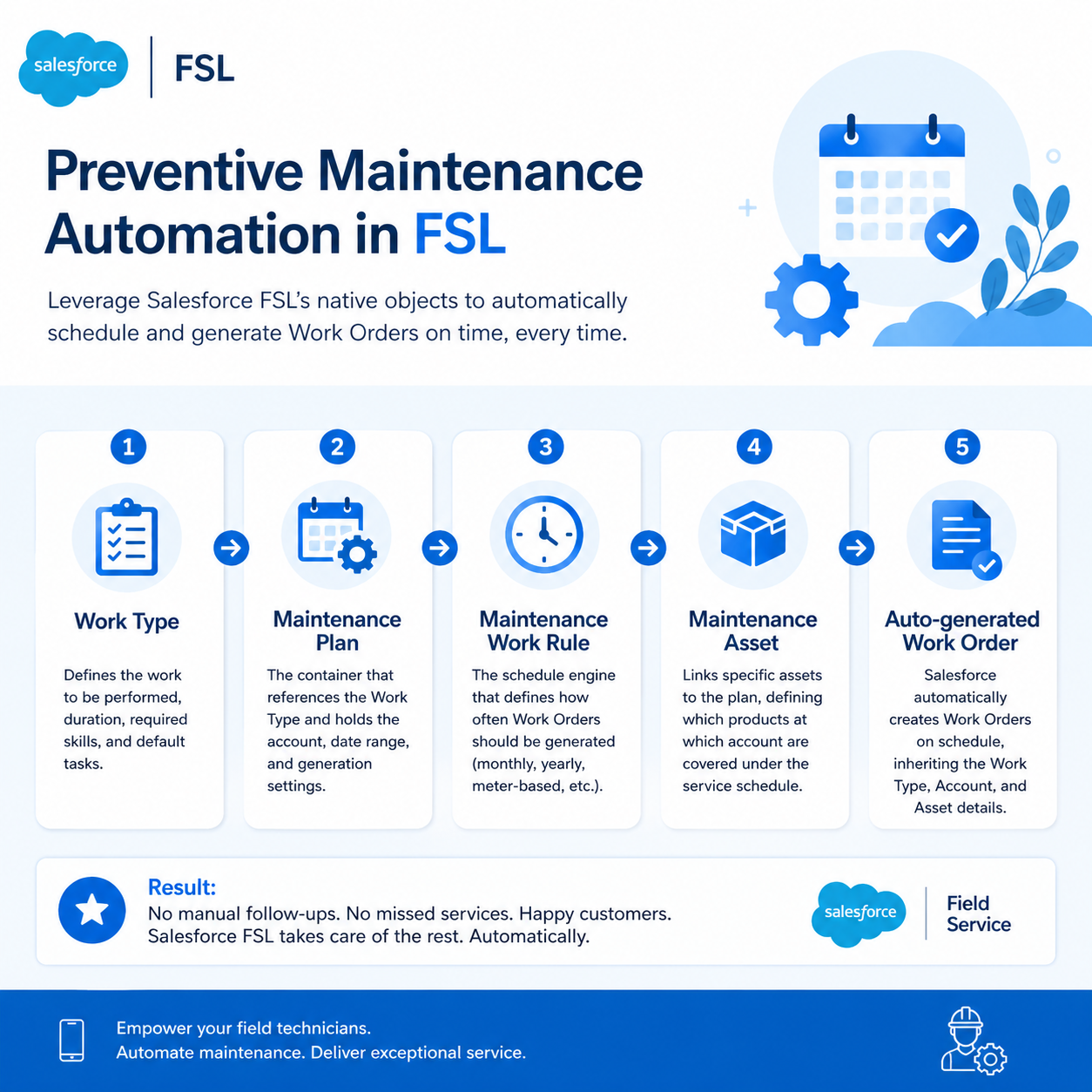
The framework relies on four primary objects working together.
1. Work Type
Work Type defines the maintenance activity being performed.
Typical configurations include:
- Annual Equipment Inspection
- Quarterly Preventive Maintenance
- HVAC Cleaning
- Generator Service
- Safety Compliance Check
Work Types establish:
- Duration
- Required Skills
- Task Templates
- Standard Operating Procedures
2. Maintenance Plan
The Maintenance Plan acts as the master container for recurring maintenance activities.
It defines:
- Customer Account
- Service Period
- Effective Dates
- Maintenance Configuration
Think of it as the central schedule manager.
3. Maintenance Work Rule
This is the most critical component.
The Maintenance Work Rule defines:
- Monthly Schedules
- Quarterly Schedules
- Annual Schedules
- Meter-Based Schedules
- Usage-Based Schedules
Without a Maintenance Work Rule, Salesforce will never generate Work Orders.
This object determines when maintenance activities should occur.
4. Maintenance Asset
Maintenance Assets identify the specific products or equipment covered under the maintenance program.
Examples include:
- HVAC Units
- Compressors
- Boilers
- Manufacturing Equipment
- Medical Devices
The Maintenance Asset links the actual customer equipment to the maintenance schedule.
OUR CUSTOM SOLUTION
Extending Native FSL with Lightning Web Components
Although Salesforce provides excellent automation capabilities, the initial setup process can still involve multiple screens and manual record creation.
To improve efficiency, we built a custom Lightning Web Component embedded inside an FSL Quick Action.
The goal was simple:
Enable technicians to configure preventive maintenance directly from the mobile application while on-site.
What the LWC Does
Asset Selection
Technicians can select one or multiple customer assets requiring recurring maintenance.
Service Contract Line Item Generation
The solution automatically creates associated service contract records.
Maintenance Plan Creation
The component generates Maintenance Plans automatically.
Maintenance Work Rule Configuration
Users select maintenance frequencies directly within the interface.
Asset Linking
Selected assets are automatically connected to the generated plans.
Mobile-Friendly Experience
Everything works directly within Salesforce Field Service Mobile.
The entire setup process can be completed in minutes.
ARCHITECTURE DESIGN
Combining Native Automation with Custom User Experience
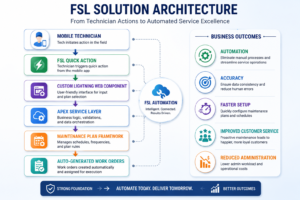
The architecture follows a layered approach.
Layer 1: User Experience
Lightning Web Component
Responsibilities:
- Asset Selection
- Validation
- User Guidance
- Mobile Optimization
- Configuration Inputs
Layer 2: Business Logic
Apex Services
Responsibilities:
- Data Validation
- Record Creation
- Relationship Management
- Error Handling
Layer 3: Salesforce FSL Framework
Responsibilities:
- Maintenance Scheduling
- Work Order Generation
- Asset Tracking
- Service History
Layer 4: Data Model
Core Objects:
- Asset
- Service Contract
- Service Contract Line Item
- Work Type
- Maintenance Plan
- Maintenance Work Rule
- Maintenance Asset
- Work Order
This separation ensures maintainability and scalability.
BUSINESS IMPACT
Real Benefits Delivered
Benefit 1: Reduced Administrative Effort
Office teams no longer spend time manually creating recurring Work Orders.
Benefit 2: Faster Field Operations
Technicians configure maintenance schedules immediately after installation.
Benefit 3: Improved Service Compliance
Maintenance visits occur on schedule.
Benefit 4: Better Customer Experience
Customers receive proactive service without needing to request support.
Benefit 5: Greater Scalability
The solution supports thousands of assets without increasing operational overhead.
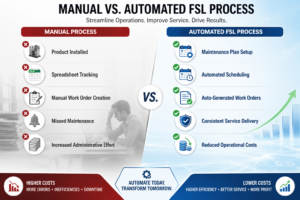
Before vs After
Before
- Manual Work Order Creation
- Spreadsheet Tracking
- Multiple Team Hand-Offs
- Missed Maintenance Opportunities
- Higher Operational Costs
After
- Automated Scheduling
- Auto-Generated Work Orders
- Mobile Setup
- Reduced Administrative Work
- Consistent Service Delivery
KEY LEARNING
What This Project Reinforced
Learning 1
Always explore standard Salesforce functionality before building custom solutions.
Learning 2
Maintenance Work Rules are the foundation of preventive maintenance automation.
Learning 3
Native FSL capabilities become significantly more powerful when combined with modern user experiences.
Learning 4
Mobile-first design increases technician adoption.
Learning 5
Automation should eliminate repetitive operational tasks whenever possible.
BEST PRACTICES
Recommendations for FSL Implementations
Best Practice 1
Use Work Types consistently across maintenance processes.
Best Practice 2
Keep Maintenance Work Rules simple and easy to manage.
Best Practice 3
Automate setup whenever possible.
Best Practice 4
Design mobile experiences for technicians in the field.
Best Practice 5
Validate asset relationships before generating maintenance plans.
Best Practice 6
Monitor generated Work Orders to ensure schedules operate correctly.
KEY INSIGHT
The Hidden Power of Salesforce Field Service
Many organizations invest heavily in custom automation while overlooking capabilities already available within Salesforce Field Service.
Preventive Maintenance is one of those hidden gems.
When configured correctly, Salesforce can automatically generate recurring Work Orders for years without additional development effort.
The real opportunity lies in enhancing the user experience around the setup process rather than rebuilding scheduling functionality that already exists.
Final Thought
Preventive Maintenance should not depend on spreadsheets, reminders, or manual Work Order creation.
Salesforce Field Service already provides a robust framework through Work Types, Maintenance Plans, Maintenance Work Rules, and Maintenance Assets.
By combining these native capabilities with a custom Lightning Web Component and mobile-first design, we transformed a manual process into a scalable, automated solution.
The best Salesforce solutions are not always the most complex. Sometimes the greatest value comes from understanding the platform deeply and extending it thoughtfully.
That’s exactly what Preventive Maintenance Automation in FSL enables.