

INTRODUCTION
The spread operator is not a flashy JavaScript feature. It does not have an impressive name. It is three dots — just three dots — and yet it quietly solves some of the most common and frustrating problems that LWC developers encounter when building Lightning Web Components.
If you have spent time reading well-written LWC code, you have seen it everywhere. Array merges. Object updates. State management. Data copies. It appears consistently in clean, reliable components — and its absence often explains why other components behave unpredictably.
This blog covers what the spread operator actually does, why it matters specifically in the context of LWC’s reactivity model, the practical operations it enables, and why understanding it changes how you read and write Lightning Web Components.
THE CHALLENGE
Why Direct Data Mutation Causes Problems in LWC
To understand why the spread operator matters in LWC, you first need to understand how Lightning Web Components track data changes and decide when to re-render the UI.
How LWC Tracks Changes:
Lightning Web Components use a reactive property system. When a tracked property changes, LWC re-renders the parts of the component that depend on that property. But LWC tracks reference changes — not value changes within an existing object or array.
This distinction is critical and is the source of a specific category of LWC bugs that are difficult to diagnose.
The Problem With Mutating Existing Data:
javascript
// This looks like it should work — but it often does not trigger re-render
@track items = [1, 2, 3];
addItem() {
this.items.push(4); // Mutates the existing array
// LWC may not detect this change because the reference is the same
// The array is the same array — just with a new item inside it
}
When you push to an existing array, the array reference does not change. LWC sees the same reference it saw before and may not trigger a re-render. The UI stays the same even though the data changed. This is the silent bug that confuses developers who are new to LWC’s reactivity model.
The Same Problem With Objects:
javascript
@track user = { name: ‘Alex’, role: ‘Admin’ };
updateRole() {
this.user.role = ‘Developer’; // Mutates the existing object
// LWC may not detect this change — same object reference
}
Directly mutating a property on an existing object does not change the object’s reference. LWC may not detect the change. The UI does not update. The developer adds logging, confirms the data changed in JavaScript, and cannot understand why the template is not reflecting it.
The Root Cause: Both problems share the same root cause — mutating existing data instead of creating new data. The spread operator solves both problems by making it easy and natural to create new arrays and new objects instead of modifying existing ones.
WHAT THE SPREAD OPERATOR DOES
Three Dots That Create New References Instead of Mutating Existing Ones
The spread operator — written as three consecutive dots (…) — expands the elements of an array or the properties of an object into a new context. When used in array or object literals, it creates an entirely new array or object that contains copies of the original data.
The Core Behavior:
javascript
const original = [1, 2, 3];
const copy = […original]; // New array, same values
console.log(original === copy); // false — different references
console.log(original); // [1, 2, 3] — unchanged
console.log(copy); // [1, 2, 3] — independent copy
The copy is a new array. It has a new reference. It contains the same values as the original. And the original is completely untouched.
This single behavior — creating new references while preserving original data — is what makes the spread operator so valuable in LWC development.
THE FIVE CORE OPERATIONS
What the Spread Operator Enables — Five Practical Patterns
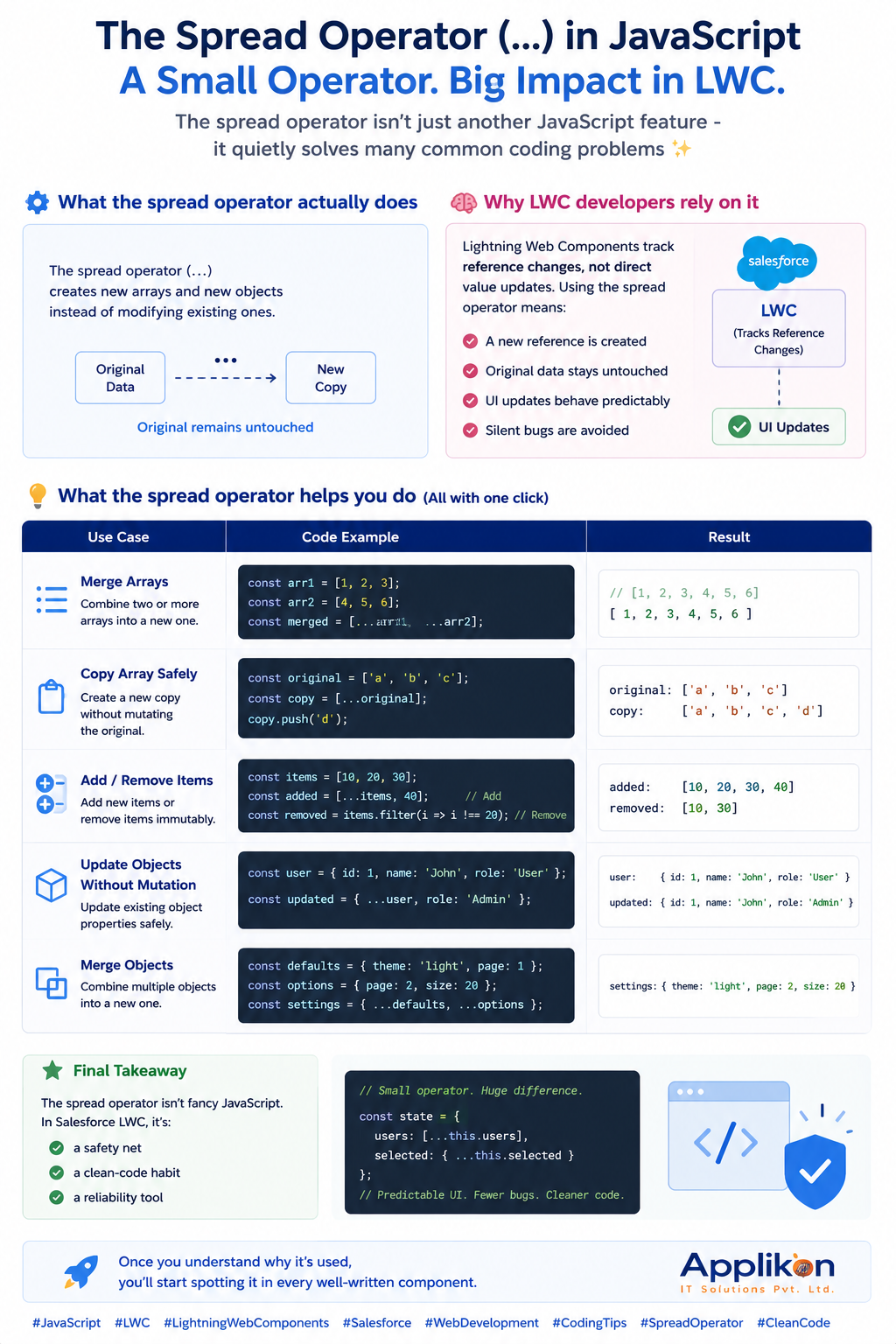
The code screenshots show five specific operations performed using the spread operator. Each one demonstrates a pattern that appears regularly in well-written LWC components.
Operation 1: Merging Arrays
javascript
const numbersOne = [1, 2, 3];
const numbersTwo = [4, 5, 6];
// Merge two arrays into a new array
const mergedArray = […numbersOne, …numbersTwo];
console.log(‘Merged Array:’, mergedArray);
// Output: Merged Array: [ 1, 2, 3, 4, 5, 6 ]
Both original arrays are spread into a new array. Neither original is modified. The merged result is a completely independent array with a new reference.
In LWC, this pattern is used when combining datasets — merging search results with existing records, combining selected items from multiple sources, or concatenating paginated data.
Operation 2: Copying an Array
javascript
const numbersOne = [1, 2, 3];
// Create an independent copy
const arrayCopy = […numbersOne];
console.log(‘Array Copy:’, arrayCopy);
// Output: Array Copy: [ 1, 2, 3 ]
The copy is not a reference to the original — it is a new array with the same values. Modifying the copy does not affect the original. This is the safe way to create a working copy of array data without risking mutation of the source.
In LWC, this pattern is used when you need to process or transform data without altering the original tracked property or the data passed in from a parent component through an @api property.
Operation 3: Adding an Item to an Array
javascript
const numbersOne = [1, 2, 3];
// Add item without mutating the original
const addItem = […numbersOne, 7];
console.log(‘Add Item:’, addItem);
// Output: Add Item: [ 1, 2, 3, 7 ]
Instead of pushing to the existing array — which mutates it and may not trigger LWC re-render — a new array is created that contains all the original items plus the new one. The original array is untouched. LWC sees a new reference and re-renders correctly.
In LWC, this is the correct pattern for adding items to a tracked list — selected options, shopping cart items, filter chips, or any list that drives UI rendering.
Operation 4: Removing an Item From an Array
javascript
const numbersOne = [1, 2, 3];
// Remove item 2 without mutating the original
const removeItem = numbersOne.filter(num => num !== 2);
console.log(‘Remove Item:’, removeItem);
// Output: Remove Item: [ 1, 3 ]
While this example uses filter rather than spread directly, it follows the same immutability principle — creating a new array rather than modifying the existing one. The filter method returns a new array containing only the elements that pass the test, leaving the original untouched.
In LWC, filter is the correct pattern for removing items from tracked lists. Combined with spread for additions, these two patterns handle the full lifecycle of list management in reactive components.
Operation 5: Updating an Object Without Mutation
javascript
const user = {
name: ‘Alex’,
role: ‘Admin’
};
// Update role without mutating the original object
const updatedUser = { …user, role: ‘Developer’ };
console.log(‘Updated User:’, updatedUser);
// Output: Updated User: { name: ‘Alex’, role: ‘Developer’ }
The spread operator copies all properties from the user object into a new object literal. The role property is then overridden with the new value. The result is a new object with the updated role — and the original user object is completely unchanged.
The order matters: properties specified after the spread override properties from the spread. Properties specified before the spread can be overridden by the spread.
In LWC, this pattern is used every time a tracked object property needs to be updated. Instead of directly mutating a property on the existing object — which may not trigger re-render — a new object with the updated values is assigned, giving LWC a new reference to detect and respond to.
WHY THIS MATTERS SPECIFICALLY IN LWC
The Connection Between Spread Operator and LWC Reactivity
The spread operator’s value in plain JavaScript is convenience and readability. Its value in LWC is correctness and reliability. Understanding this distinction is what separates developers who use the spread operator habitually from those who use it occasionally.
LWC’s Reactivity Model in Plain Terms:
When you assign a new value to a tracked property, LWC detects the change and updates the UI. When the value is a primitive — a string, number, boolean — every assignment creates a new value automatically. But when the value is an array or object, assignment only triggers re-render if the reference changes.
javascript
// This triggers re-render — new array reference
this.items = […this.items, newItem];
// This may NOT trigger re-render — same array reference
this.items.push(newItem);
The spread operator makes creating new references the natural, easy path. Without it, creating a new reference requires more verbose code that developers are tempted to shortcut. With it, the correct pattern is as simple as the incorrect one.
Three Guarantees the Spread Operator Provides in LWC:
- A new reference is created — LWC detects the change and re-renders
- Original data stays untouched — parent data, @api properties, and source records are not accidentally modified
- UI updates behave predictably — the component renders based on the new data, every time, without mysterious non-updates
The Bugs It Prevents:
- UI not updating after adding an item to a list
- Tracked property appearing changed in console but not reflected in template
- @api property from parent component being accidentally mutated in child
- Shared array state being modified in one component and unexpectedly affecting another
- Object updates not triggering template re-renders
KEY LEARNING
What Understanding the Spread Operator Teaches About LWC
Learning 1: Immutability Is a Practice, Not a Constraint Treating data as immutable — never modifying it directly, always creating new versions — is not a limitation that JavaScript or LWC imposes. It is a practice that produces more predictable, more debuggable, and more reliable code. The spread operator makes this practice easy enough to follow consistently.
Learning 2: Understanding the Reactivity Model Changes Everything Many LWC bugs that seem mysterious become completely understandable once you know that LWC tracks references, not values within existing objects or arrays. Once you understand this, the spread operator is not just a convenience — it is the natural solution to a specific, well-understood problem.
Learning 3: Clean Code and Correct Code Are the Same Code Here Code that uses the spread operator to create new arrays and objects is simultaneously cleaner to read and more correct in its behavior. This is not always true in software development — sometimes correctness requires verbosity. In this case, the readable pattern and the correct pattern are identical.
Learning 4: @api Properties Require Extra Care Data passed into a child component through @api properties must never be mutated directly. The parent component owns that data. Mutating it in the child creates unpredictable shared state between components. The spread operator makes it easy to create safe working copies that can be modified freely without affecting the parent’s data.
Learning 5: Once You See It, You See It Everywhere Once you understand why the spread operator is used in LWC, you start recognising it in every well-written component. This recognition makes reading other developers’ code faster and more intuitive. It is one of those patterns that, once internalised, fundamentally improves your ability to read and write LWC code.
KEY INSIGHT
A Safety Net, a Clean-Code Habit, and a Reliability Tool — All in Three Dots
The spread operator is not advanced JavaScript. It is not a performance optimization. It is not a workaround for a framework limitation.
It is the natural expression of a principle that produces better software: treat data as immutable, create new versions rather than modifying existing ones, and let the framework’s reactivity system do its job by giving it the new references it needs to detect changes.
In Salesforce LWC, this principle is not optional. It is the difference between components that update predictably and components that behave mysteriously. Between code that is easy to debug and code that requires hours of investigation to understand why the UI is not reflecting what the data says.
Three dots. Used consistently. For dramatically more reliable components.
Final Thought
The spread operator is one of those things in LWC development where understanding the why changes how you write code permanently. Not because it unlocks capabilities you did not have before — you could always create new arrays and objects manually. But because it makes the right thing easy enough to do every time, without thinking about it.
Once you understand that LWC tracks references, that direct mutation silently breaks reactivity, and that the spread operator creates new references naturally — you will not need to remind yourself to use it. It will become the obvious, automatic choice for every array and object update in every component you write.
Spot it in existing code. Understand why it is there. Start using it consistently in your own. Your components will be cleaner, more reliable, and significantly easier for the next developer to understand.