

If you’re evaluating Salesforce for complex product configuration, pricing, quoting, subscriptions, or revenue operations, you may be wondering:
Should you use Salesforce CPQ or Salesforce Revenue Cloud in 2026?
The answer is different today than it was a few years ago.
Salesforce CPQ remains a supported product for existing customers, but Salesforce has moved to an end-of-sale model for new CPQ licenses. Salesforce’s strategic investment is now focused on Revenue Cloud, which Salesforce currently refers to as Revenue Management / Agentforce Revenue Management.
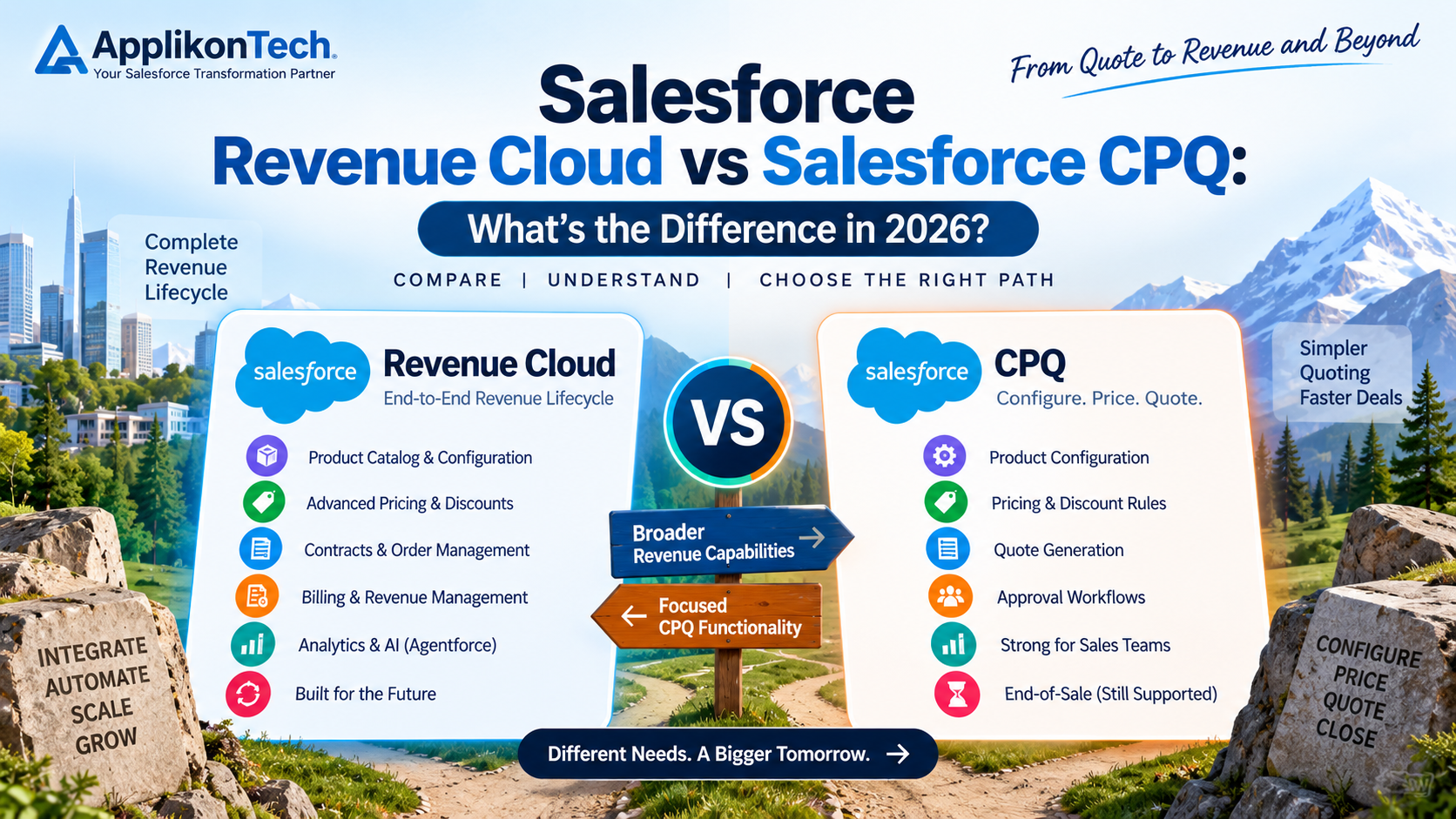
Revenue Cloud isn’t simply a renamed version of Salesforce CPQ. Salesforce describes it as a separate system with a different architecture, data model, configuration approach, and broader capabilities.
So, what’s the difference?
Let’s compare them.
Salesforce Revenue Cloud vs Salesforce CPQ: Quick Comparison
| Feature | Salesforce CPQ | Revenue Cloud |
|---|---|---|
| Architecture | Managed package | Native Salesforce architecture |
| Primary focus | Configure, Price, Quote | Complete revenue lifecycle |
| Product configuration | Yes | Yes |
| Pricing | Yes | Yes |
| Quoting | Yes | Yes |
| Subscriptions | Supported | Native broader revenue model support |
| Consumption-based pricing | Limited compared with Revenue Cloud | Supported |
| Order management | Available through Salesforce ecosystem | Broader native capabilities |
| Contracts | Separate/limited | Native capabilities available depending on license |
| Billing | Separate Salesforce Billing solution | Revenue Cloud Billing / broader revenue capabilities |
| APIs | CPQ APIs | API-first architecture |
| AI | Limited compared with current Revenue Cloud direction | Agentforce capabilities |
| New customer direction | End of sale | Strategic Salesforce direction |
| Migration | Existing customers can continue | New implementations should evaluate Revenue Cloud |
Salesforce itself describes Revenue Management as a separate product from Salesforce CPQ, with Revenue Management built on Salesforce’s platform while CPQ is a managed package.
What Is Salesforce CPQ?
CPQ stands for Configure, Price, Quote.
Salesforce CPQ was designed to help sales teams manage complex products, configure customer requirements, calculate prices, apply discounts, and generate quotes.
A typical CPQ process looks like:
Configure → Price → Approve → Quote
Salesforce CPQ can help businesses:
- Configure complex products
- Create product bundles
- Apply pricing rules
- Apply discounts
- Generate quotes
- Manage approvals
- Automate parts of the sales process
- Support complex selling scenarios
Salesforce describes CPQ as software that helps businesses configure products, price deals accurately, and create quotes.
What Is Salesforce Revenue Cloud?
Revenue Cloud was created to go beyond traditional CPQ.
It expands the revenue process from simply creating a quote to managing more of the quote-to-cash and revenue lifecycle.
Salesforce’s current Revenue Management capabilities cover areas including:
- Product catalog management
- Pricing
- Product configuration
- Quoting
- Order management
- Contracts
- Consumption
- Billing
- Revenue operations
- Analytics
- AI-powered workflows
Salesforce describes Revenue Cloud as an API-first platform designed to support quoting, pricing, ordering, billing, and other revenue-critical processes.
The Biggest Difference: Scope
The easiest way to understand the difference is:
Salesforce CPQ
Mainly focuses on:
Configure → Price → Quote
Revenue Cloud
Extends the process toward:
Product → Configure → Price → Quote → Contract → Order → Consume → Bill → Revenue
This broader scope is one of the biggest reasons Salesforce is moving customers toward Revenue Cloud.
Salesforce states that Revenue Cloud expands beyond CPQ to include capabilities such as contract lifecycle management, order management, asset lifecycle management, billing, invoicing, and revenue analytics.
Architecture: Salesforce CPQ vs Revenue Cloud
This is an important technical difference.
Salesforce CPQ
Salesforce CPQ is a managed package installed on the Salesforce platform.
Salesforce’s documentation describes CPQ as having a managed-package architecture.
Revenue Cloud
Revenue Cloud / Revenue Management uses a native Salesforce platform architecture and an API-first approach.
This can make Revenue Cloud more suitable for organizations that want to connect revenue processes across different channels and systems.
Why does architecture matter?
A native, API-first architecture can make it easier to expose revenue processes through:
- Web applications
- Partner portals
- Self-service experiences
- Internal Salesforce applications
- External systems
- APIs
Pricing: CPQ vs Revenue Cloud
Both platforms support pricing, but the underlying approach is different.
Salesforce CPQ traditionally uses:
- Price books
- Discount schedules
- Block pricing
- Pricing rules
- Quote calculations
Revenue Cloud introduces a more flexible pricing architecture based around:
- Pricing procedures
- Pricing elements
- Decision tables
- Price adjustments
- Attribute-based pricing
- Volume pricing
- Subscription pricing
- Consumption-based models
Salesforce describes Revenue Management as supporting multiple pricing models including one-time, subscription, and consumption-based models.
For complex pricing environments, this can be a significant advantage.
Revenue Cloud Pricing Procedures vs CPQ Pricing Rules
This is another major technical difference.
In traditional Salesforce CPQ, pricing logic is heavily tied to CPQ’s managed-package architecture and quote calculation process.
Revenue Cloud uses pricing procedures and pricing elements to construct pricing logic.
A simplified Revenue Cloud pricing process could look like:
List Price
↓
Pricing Procedure
↓
Decision Table
↓
Discount
↓
Price Adjustment
↓
Final Price
This makes pricing logic more configurable and suitable for complex pricing scenarios.
Product Configuration
Both platforms can support complex product configuration.
However, Revenue Cloud introduces a more modern approach to product modeling.
Salesforce describes CPQ as primarily SKU-based with bundle and option hierarchies, while Revenue Cloud uses an attribute-based approach that separates commercial and technical products.
This distinction can become important for organizations with:
- Large product catalogs
- Complex configurations
- Multiple product variants
- Technical products
- Subscription offerings
- Multiple selling models
Subscription and Consumption-Based Pricing
This is one area where Revenue Cloud has a significant advantage.
Modern businesses increasingly sell products through:
- Monthly subscriptions
- Annual subscriptions
- Usage-based pricing
- Consumption pricing
- Hybrid pricing
- Recurring services
Revenue Cloud was designed to support these models.
Salesforce specifically highlights support for subscription, consumption, and hybrid revenue models.
For example:
SaaS company
Instead of:
$10,000 one-time license
the company could sell:
$1,000/month subscription
- usage charges
- additional users
- premium support
Revenue Cloud is designed for this type of revenue model.
Billing: CPQ vs Revenue Cloud
This is another important difference.
Salesforce CPQ primarily handles the configure, price, and quote portion of the sales process.
Billing historically required separate Salesforce products and integrations.
Revenue Cloud expands into billing and revenue management.
Salesforce’s current Revenue Management licensing documentation shows that billing capabilities vary by license, with Revenue Cloud Billing providing the broader billing feature set.
So organizations should evaluate the entire revenue architecture rather than comparing CPQ and Revenue Cloud only on quoting.
Contracts and Order Management
Revenue Cloud also extends further into post-quote processes.
Depending on the edition and architecture, Revenue Cloud can support:
- Contracts
- Orders
- Order decomposition
- Fulfillment orchestration
- Billing
- Consumption management
Salesforce’s comparison specifically identifies order management, contracts, and billing as areas where Revenue Management goes beyond Salesforce CPQ.
Salesforce CPQ vs Revenue Cloud: AI
AI is another major difference in 2026.
Salesforce is incorporating Agentforce into Revenue Management.
Salesforce says Agentforce Revenue Management can support AI-powered tasks such as:
- Quote generation
- Quote management
- Consumption monitoring
- Billing inquiries
- Revenue workflows
Is Salesforce CPQ Being Discontinued?
This is one of the most important questions for existing Salesforce CPQ customers.
No — Salesforce CPQ is not currently end-of-life.
However, Salesforce announced that CPQ is end-of-sale.
That means:
- Existing customers can continue using CPQ.
- Existing customers can renew their licenses.
- Existing customers can purchase additional users under the applicable terms.
- Salesforce continues to support existing CPQ customers.
- Salesforce is no longer selling new Salesforce CPQ licenses to new customers.
Salesforce states that its strategic investment has shifted toward Revenue Cloud Advanced and the broader Agentforce Revenue Management suite.
Salesforce has not announced an official CPQ end-of-life date.
Should Existing Salesforce CPQ Customers Migrate?
Not necessarily immediately.
If your existing CPQ implementation is working well, you don’t need to panic.
However, migration should be evaluated if you’re planning:
- Major Salesforce transformation
- New revenue models
- Subscription expansion
- Consumption-based pricing
- Digital selling
- Advanced billing
- Complex order orchestration
- New AI-powered revenue processes
- Replacement of legacy revenue architecture
Salesforce specifically recommends treating CPQ-to-Revenue Management migration as a redesign rather than a simple configuration migration, because the platforms use different architecture and data models.
Can You Upgrade Salesforce CPQ Directly to Revenue Cloud?
This is an important misconception.
Revenue Cloud is not simply a new version of Salesforce CPQ.
Salesforce’s documentation states that Revenue Management is a separate product and that moving from Salesforce CPQ requires a full reimplementation, rather than installing a simple upgrade or patch.
Therefore, businesses considering migration should plan for:
- Architecture review
- Data model mapping
- Product catalog assessment
- Pricing redesign
- Integration assessment
- Configuration redesign
- Data migration
- Testing
- User training
- Deployment
Revenue Cloud Pricing in 2026
Salesforce currently lists:
Revenue Cloud Growth
$150 USD/user/month
billed annually.
It includes capabilities such as:
- Quoting & Configurator
- Order Capture
- Subscriptions
Revenue Cloud Advanced
$200 USD/user/month
billed annually.
It adds capabilities including:
- Contracts & Orders
- Consumption & Invoicing
- AI & Analytics
Salesforce notes that pricing is subject to change and that Revenue Cloud Advanced requires an annual contract.
Actual project cost will also depend on:
- Number of users
- Implementation complexity
- Data migration
- Integrations
- Customization
- Billing requirements
- Product catalog complexity
- Consulting requirements
Salesforce Revenue Cloud vs CPQ: Which One Should You Choose?
Choose Salesforce CPQ if:
You are an existing CPQ customer and:
- Your current implementation works well
- Your business primarily needs quoting
- You don’t need major new revenue models
- Your current integrations are stable
- You’re not planning a major revenue transformation
Consider Revenue Cloud if:
You need:
- Complex pricing
- Subscription management
- Consumption-based pricing
- Advanced product configuration
- Order management
- Contract management
- Billing
- Multiple selling channels
- API-first architecture
- AI-powered revenue processes
- A broader quote-to-cash platform
Salesforce Revenue Cloud vs CPQ: Final Verdict
The difference can be summarized simply:
Salesforce CPQ is primarily a configure-price-quote solution, while Revenue Cloud is designed to manage a much broader revenue lifecycle.
CPQ remains an important and supported solution for existing customers, but Salesforce’s product direction in 2026 is clearly moving toward Revenue Cloud / Agentforce Revenue Management.
For a new Salesforce implementation, businesses should evaluate Revenue Cloud rather than automatically selecting legacy Salesforce CPQ.
For existing CPQ customers, the decision should be based on business requirements, technical architecture, revenue models, and long-term roadmap—not simply because CPQ is now end-of-sale.
Frequently Asked Questions
Is Salesforce Revenue Cloud replacing CPQ?
Revenue Cloud is the strategic successor to Salesforce CPQ, but it is a separate product with a different architecture rather than a simple CPQ upgrade.
Is Salesforce CPQ still supported in 2026?
Yes. Salesforce CPQ is end-of-sale, not end-of-life, and existing customers can continue using and renewing it under applicable terms.
Is Revenue Cloud better than Salesforce CPQ?
For organizations needing broader revenue lifecycle capabilities, subscriptions, consumption models, billing, contracts, and modern API/AI capabilities, Revenue Cloud is generally the more strategic option. Existing CPQ customers may not need to migrate immediately.
Can Salesforce CPQ migrate to Revenue Cloud?
Yes, but Salesforce describes the move as a reimplementation/redesign, not a simple upgrade.
Is Revenue Cloud the same as Revenue Management?
Salesforce’s current documentation uses Revenue Management for the product formerly known as Revenue Cloud; you’ll also encounter names such as Revenue Cloud Advanced and Revenue Lifecycle Management.