

Choosing the right Salesforce Revenue Cloud implementation partner can have a major impact on the success of your CRM and revenue transformation project.
Revenue processes are rarely simple. Businesses may need to manage complex product catalogs, pricing rules, discounts, approvals, quotes, contracts, orders, subscriptions, usage-based models, and integrations with other business systems.
A poorly planned implementation can result in unnecessary customization, data problems, integration failures, low user adoption, and higher long-term costs.
The right Salesforce Revenue Cloud partner should do more than configure Salesforce. They should understand your revenue processes, identify operational gaps, design a scalable architecture, and create an implementation roadmap aligned with your business goals.
This guide explains how to evaluate a Revenue Cloud implementation company, what capabilities to look for, which questions to ask potential partners, and how to determine whether a consulting partner is the right fit for your organization.
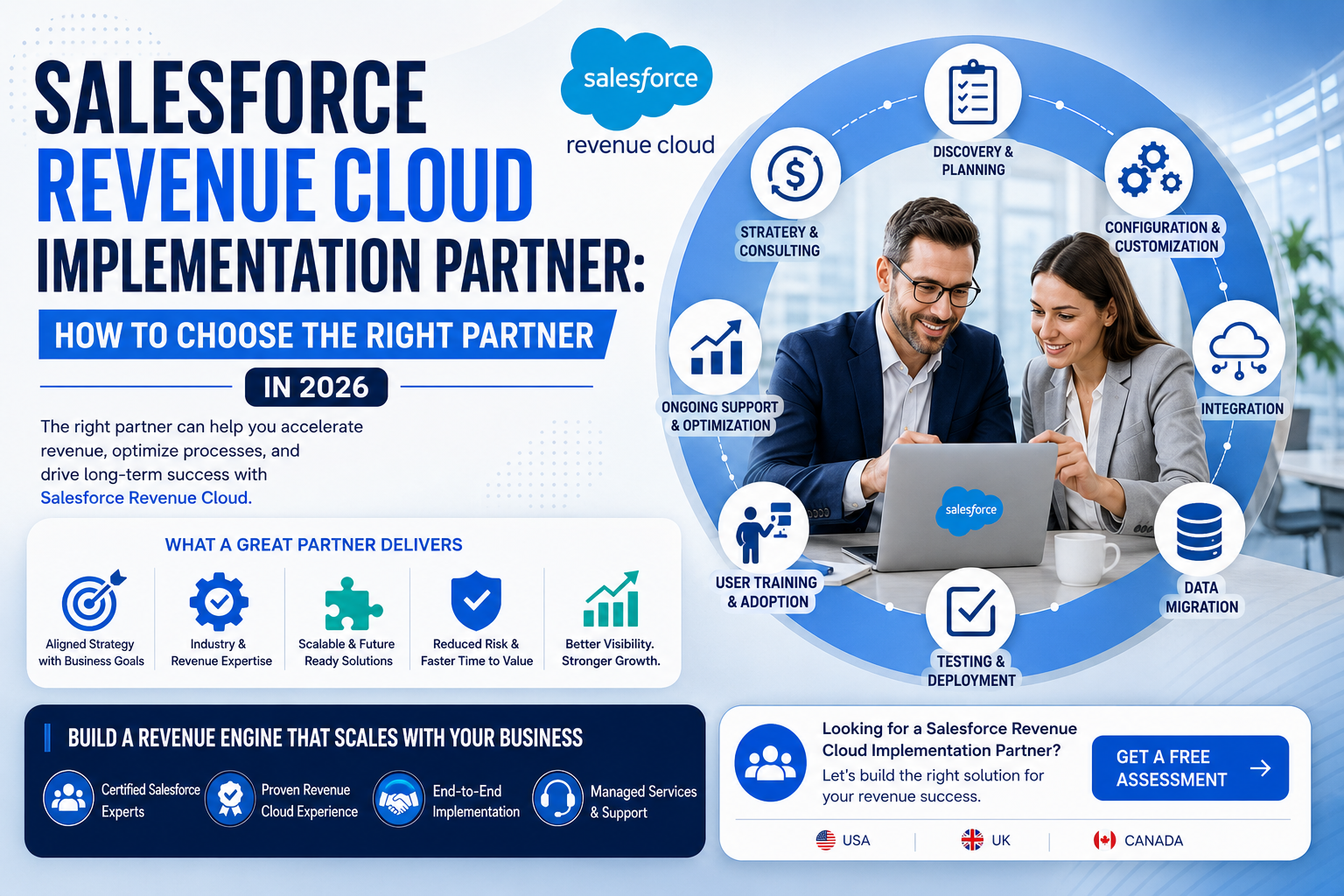
What Is a Salesforce Revenue Cloud Implementation Partner?
A Salesforce Revenue Cloud implementation partner is a consulting company that helps businesses plan, configure, customize, integrate, test, deploy, and optimize Revenue Cloud.
Depending on your requirements, implementation services may cover:
- Business process discovery
- Revenue process assessment
- Product catalog configuration
- Pricing configuration
- Product and bundle setup
- Quote configuration
- Approval automation
- Contract processes
- Order management
- Subscription and usage-based processes
- Data migration
- Third-party integrations
- Custom development
- Testing and quality assurance
- User training
- Go-live support
- Post-launch optimization
A capable partner connects the technology with the business process instead of treating implementation as a simple software configuration exercise.
Why Choosing the Right Revenue Cloud Partner Matters
Revenue Cloud can become an important part of your sales and revenue operations.
If the implementation is not designed properly, problems can appear across multiple departments.
For example, incorrect product or pricing configuration can affect quoting. Poor data architecture can create reporting problems. Weak integration design can create disconnected information between Salesforce and ERP, billing, finance, or other systems.
A strong implementation partner helps reduce these risks by addressing the architecture and business requirements before configuration begins.
The right partner can help you:
- Standardize revenue processes
- Reduce manual work
- Improve pricing accuracy
- Automate approvals
- Improve quote-to-cash processes
- Connect Salesforce with other systems
- Improve data visibility
- Increase user adoption
- Create a scalable CRM architecture
10 Things to Look for in a Salesforce Revenue Cloud Implementation Partner
1. Proven Salesforce Expertise
Start by evaluating the partner’s Salesforce experience.
Look for a team with relevant Salesforce certifications, implementation experience, and technical expertise across the Salesforce ecosystem.
Your partner may need expertise in areas such as:
- Revenue Cloud
- Salesforce CPQ
- Sales Cloud
- Service Cloud
- Data Cloud
- Salesforce integrations
- Apex and Lightning development
- Salesforce Flow
- Data migration
The broader your Salesforce environment, the more important cross-platform expertise becomes.
2. Revenue Process Experience
A Revenue Cloud implementation should start with your business processes—not with configuration screens.
Your partner should understand how your company handles:
Product → Pricing → Quote → Contract → Order → Billing → Revenue
They should ask questions about:
- Product structures
- Pricing models
- Discounting
- Approvals
- Renewals
- Amendments
- Subscriptions
- Usage-based pricing
- Order processes
- Revenue operations
A partner that understands your commercial model can design a more practical Salesforce solution.
3. Strong Discovery and Planning Process
One of the biggest implementation mistakes is moving into configuration too quickly.
Before implementation begins, your Revenue Cloud consulting partner should conduct a discovery phase.
This should identify:
- Business requirements
- Existing Salesforce architecture
- Current workflows
- Data sources
- Integrations
- User requirements
- Security requirements
- Reporting needs
- Technical limitations
- Future scalability requirements
The outcome should be a documented implementation roadmap.
4. Experience With Complex Pricing
Pricing is often one of the most complicated parts of a Revenue Cloud implementation.
Your business may have:
- Volume-based pricing
- Tiered pricing
- Contract pricing
- Customer-specific pricing
- Discounts
- Promotional pricing
- Subscription pricing
- Usage-based pricing
- Product dependencies
Your Salesforce Revenue Cloud consultant should be able to translate these business rules into a maintainable Salesforce architecture.
The goal should not simply be to make today’s pricing work.
It should be to create a system that can support future pricing changes without constant custom development.
5. Integration Expertise
Revenue processes rarely exist entirely inside Salesforce.
Your Revenue Cloud environment may need to communicate with:
- ERP platforms
- Accounting systems
- Payment platforms
- Billing systems
- E-commerce platforms
- Data warehouses
- Marketing platforms
- Customer service applications
Ask potential partners how they approach integration architecture.
A strong Salesforce implementation partner should clearly explain:
- What system owns each data element
- How data is synchronized
- How errors are handled
- How integrations are monitored
- How APIs are secured
- How the architecture can scale
6. Data Migration Experience
Data migration can determine whether your new Salesforce environment starts successfully or with problems.
Before migration, your partner should evaluate:
- Duplicate records
- Incomplete information
- Legacy fields
- Product data
- Customer records
- Historical transactions
- Contracts
- Pricing data
A good migration process generally follows:
Extract → Clean → Transform → Validate → Migrate → Test
Do not assume that every piece of legacy data needs to be moved.
Your implementation partner should help determine what data is actually valuable for the new system.
7. Clear Implementation Methodology
Ask the Revenue Cloud implementation company to explain exactly how the project will be delivered.
A typical implementation can include:
Phase 1: Discovery
Understand business requirements and existing processes.
Phase 2: Solution Design
Define architecture, data model, integrations, and Salesforce configuration.
Phase 3: Configuration & Development
Build products, pricing, workflows, automation, integrations, and custom functionality.
Phase 4: Data Migration
Prepare, clean, validate, and migrate required data.
Phase 5: Testing
Perform functional, integration, user acceptance, and regression testing.
Phase 6: Training
Prepare administrators and end users for the new processes.
Phase 7: Go-Live
Deploy the solution and monitor production processes.
Phase 8: Optimization
Address post-launch issues and identify opportunities for continuous improvement.
8. Transparent Pricing
Before signing an agreement, understand exactly how the partner charges.
Revenue Cloud implementation pricing may depend on:
- Number of users
- Business complexity
- Salesforce products
- Customization
- Integrations
- Data migration
- Development requirements
- Project timeline
- Support requirements
Ask for a clear statement of:
- Project scope
- Deliverables
- Estimated timeline
- Consulting resources
- Implementation costs
- Change request process
- Post-launch support
Avoid choosing a partner based only on the lowest initial quote.
A lower upfront price can become expensive if the implementation requires extensive rework later.
9. Post-Implementation Support
Go-live is not the end of a Salesforce Revenue Cloud project.
Your team may need help with:
- User questions
- Bug fixes
- New automation
- Pricing changes
- Integration issues
- Reports
- Performance
- New Salesforce releases
- Additional functionality
Ask whether the partner offers Revenue Cloud managed services or ongoing Salesforce support.
A long-term partner can help your organization continuously optimize its Salesforce environment as business requirements change.
10. Case Studies and Client Evidence
Before hiring a Salesforce consulting company, examine its previous work.
Look for evidence related to:
- Revenue Cloud
- Salesforce CPQ
- Complex pricing
- Quote-to-cash
- Data migration
- Integrations
- CRM transformation
Don’t only ask:
“Have you implemented Salesforce?”
Ask:
“Have you solved a business problem similar to ours?”
Relevant experience is more valuable than a generic list of Salesforce services.
Questions to Ask Before Hiring a Revenue Cloud Partner
Before selecting a partner, ask:
- How many Revenue Cloud implementations have you completed?
- Have you worked with businesses similar to ours?
- Who will manage our implementation?
- Which Salesforce certifications does the project team hold?
- How do you approach discovery and solution architecture?
- How will you handle our existing Salesforce customizations?
- What integrations will be required?
- How will you approach data migration?
- What testing methodology do you use?
- What happens after go-live?
- Do you provide managed Salesforce support?
- How do you handle changes to project scope?
- What documentation will we receive?
- Can you provide relevant case studies or references?
The answers will help you distinguish between a company that simply sells implementation hours and a partner that can take ownership of the broader transformation.
Salesforce Revenue Cloud Partner vs Freelancer
For smaller Salesforce tasks, an independent consultant may be sufficient.
For a complex Revenue Cloud transformation, however, businesses may benefit from a team with multiple areas of expertise.
| Requirement | Freelancer | Revenue Cloud Consulting Company |
|---|---|---|
| Basic Salesforce Administration | Suitable | Suitable |
| Small Configuration Changes | Suitable | Suitable |
| Complex Revenue Architecture | Limited | Stronger |
| Multiple Specialists | Limited | Available |
| Data Migration | Varies | Dedicated expertise |
| Complex Integrations | Varies | Broader capability |
| Project Management | Limited | Usually available |
| QA & Testing | Limited | Dedicated resources |
| Long-Term Support | Varies | Usually available |
| Enterprise Scalability | Limited | Stronger |
The right choice depends on the size and complexity of your project.
When Should You Hire a Salesforce Revenue Cloud Consultant?
You should consider professional Revenue Cloud consulting services if:
- Your pricing processes are becoming difficult to manage.
- Sales teams rely heavily on spreadsheets.
- Your quote process is slow.
- Pricing rules are highly customized.
- You are introducing subscriptions or usage-based pricing.
- Salesforce and ERP data are disconnected.
- Your current CPQ architecture is difficult to maintain.
- You are planning a Revenue Cloud migration.
- Your business is expanding rapidly.
- You need a scalable quote-to-cash architecture.
If you’re uncertain about whether Revenue Cloud is appropriate for your business, start with an assessment rather than immediately committing to a large implementation.
How to Evaluate a Salesforce Revenue Cloud Implementation Company
Create a shortlist of three to five potential partners and evaluate them using the same criteria.
| Evaluation Area | What to Check |
| Salesforce Expertise | Certifications and relevant experience |
| Revenue Cloud Experience | Previous Revenue Cloud projects |
| Industry Knowledge | Experience with similar businesses |
| Technical Capability | Development, integrations and data |
| Methodology | Discovery, design, testing and deployment |
| Communication | Project management and reporting |
| Pricing | Transparent scope and costs |
| Support | Post-launch and managed services |
| Proof | Case studies and testimonials |
| Scalability | Ability to support future growth |
This makes the selection process more objective and reduces the risk of choosing a partner based solely on price.
Why Choose ApplikonTech for Salesforce Revenue Cloud Services?
ApplikonTech helps businesses across the USA, UK, and Canada plan, implement, customize, integrate, and optimize Salesforce solutions.
Our Salesforce Revenue Cloud services can support organizations with:
- Revenue Cloud Consulting
- Revenue Cloud Implementation
- Product and Pricing Configuration
- Salesforce CPQ
- Quote Automation
- Revenue Process Optimization
- Data Migration
- Salesforce Integration
- Workflow Automation
- Custom Salesforce Development
- Testing and Deployment
- Post-Implementation Support
- Salesforce Managed Services
Our approach focuses on understanding the business process first and then designing Salesforce around those requirements.
Whether you’re starting a new Revenue Cloud implementation, evaluating your existing CPQ environment, or looking to optimize complex pricing and revenue processes, we can help you build a practical roadmap.
Frequently Asked Questions
What does a Salesforce Revenue Cloud implementation partner do?
A partner helps businesses plan, configure, customize, integrate, test, deploy, and optimize Salesforce Revenue Cloud based on their business requirements.
How do I choose the right Salesforce Revenue Cloud partner?
Evaluate Salesforce expertise, Revenue Cloud experience, industry knowledge, implementation methodology, technical capabilities, pricing transparency, case studies, and post-launch support.
How much does Salesforce Revenue Cloud implementation cost?
There is no universal price. Cost depends on business complexity, users, Salesforce products, integrations, customization, data migration, and project scope. A discovery assessment is usually required to provide a reliable estimate.
How long does a Revenue Cloud implementation take?
The timeline varies significantly based on project scope, integrations, data complexity, customization, testing, and organizational readiness. A simple implementation can be considerably shorter than a complex multi-system transformation.
Can a Salesforce partner help with CPQ to Revenue Cloud migration?
Yes. An experienced Salesforce consulting partner can assess your existing CPQ architecture, customizations, data, integrations, and business processes before recommending whether migration or optimization is appropriate.
Do I need ongoing Salesforce support after implementation?
Many businesses benefit from ongoing administration, optimization, technical support, release management, and new feature development after go-live.
Final Thoughts
Selecting a Salesforce Revenue Cloud implementation partner is a strategic decision, not simply a procurement exercise.
The right partner should understand your business model, revenue processes, Salesforce architecture, data, integrations, and long-term goals.
Don’t choose a consulting company solely because it offers the lowest hourly rate.
Instead, evaluate:
Experience + Architecture + Business Understanding + Technical Expertise + Support + Proven Results.
A strong partner can help you avoid unnecessary customization, reduce implementation risks, improve adoption, and build a Revenue Cloud environment that can scale with your business.
Planning a Salesforce Revenue Cloud Implementation?
If you’re evaluating Salesforce Revenue Cloud, upgrading your CPQ environment, or dealing with complex pricing and revenue processes, ApplikonTech can help.
Get a Free Salesforce Revenue Cloud Assessment
Our team can review your current Salesforce environment, understand your business requirements, identify potential gaps, and recommend a practical implementation or optimization roadmap.
Talk to a Salesforce Revenue Cloud Consultant
Request Your Free Assessment
ApplikonTech supports businesses across the USA, UK, and Canada with Salesforce consulting, implementation, integration, and managed services.