

INTRODUCTION
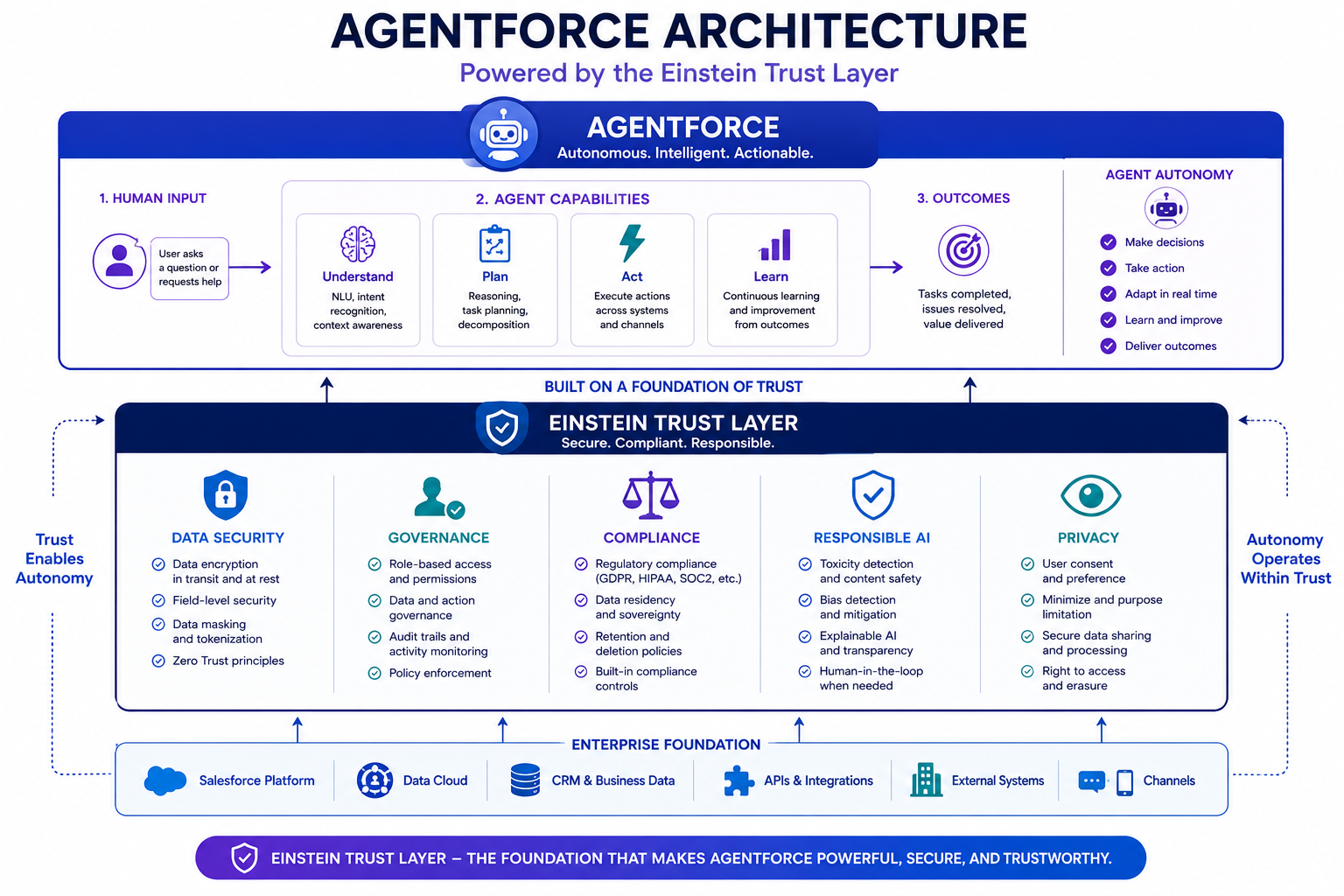
Agentforce brings autonomous AI agents into Salesforce — agents that can reason, act, and complete complex tasks across sales, service, marketing, and operations without constant human intervention. The capability is powerful. But capability alone is not enough for enterprise adoption.
What makes Agentforce genuinely enterprise-ready is not the intelligence of the agents. It is the trust infrastructure that governs how they operate.
That infrastructure is the Einstein Trust Layer.
Built directly into Agentforce, the Einstein Trust Layer ensures that every AI interaction — every prompt sent, every response generated, every action taken — happens within a framework of security, privacy, and compliance. It is not a separate product or an optional add-on. It is the foundation on which every Agentforce capability runs.
This blog covers what the Einstein Trust Layer is, why it exists, the five pillars that define it, and why it represents the right approach to deploying AI in enterprise environments.
THE CHALLENGE
Why Enterprise AI Adoption Has a Trust Problem
Artificial intelligence is transforming what software can do. But in enterprise environments, the excitement around AI capability is matched by serious, legitimate concerns about what happens to data when AI is involved.
The Questions Every Enterprise Asks Before Adopting AI:
- Where does our customer data go when it is sent to an AI model?
- Is our data being used to train models that other companies will benefit from?
- How do we ensure sensitive information — financial data, personal identifiers, health records — is not exposed in AI responses?
- Do AI agents respect our existing security model and data sharing rules?
- Can we audit what an AI agent did, why it did it, and what data it accessed?
- How do we maintain regulatory compliance when AI is making or influencing decisions?
These are not theoretical concerns. They are the questions that legal teams, compliance officers, and CISOs ask before any AI deployment is approved. Without clear answers, AI adoption stalls — not because the technology is not valuable, but because the governance framework around it is insufficient.
The Einstein Trust Layer exists to answer every one of these questions definitively.
WHAT THE EINSTEIN TRUST LAYER IS
Trust Built Into the Platform, Not Bolted On
The Einstein Trust Layer is Salesforce’s built-in AI security and governance framework. It sits between Agentforce and the large language models that power it, managing every interaction to ensure data is protected, responses are grounded, and actions are auditable.
The critical distinction is where it lives: the Einstein Trust Layer is not an external compliance wrapper or a policy document. It is embedded in the platform architecture itself. Every Agentforce interaction flows through it automatically, without requiring developers or admins to implement separate security controls.
What This Means in Practice:
- Security and privacy protections apply by default, not by configuration
- There is no way to bypass the Trust Layer — it is structural, not optional
- Every organization using Agentforce benefits from the same protections regardless of how they configure their agents
- Trust is a platform guarantee, not a customer responsibility
This approach reflects a deliberate design philosophy: in enterprise AI, trust cannot be optional. It must be foundational.
THE FIVE PILLARS OF THE EINSTEIN TRUST LAYER
Five Guarantees That Make Agentforce Enterprise-Safe
Pillar 1: Zero Data Retention
Customer data sent to large language models through Agentforce is never stored by the LLM provider and is never used to train AI models — not Salesforce’s models and not third-party models.
When an Agentforce agent processes a prompt that includes customer data, that data is used only to generate the response for that specific interaction. Once the interaction is complete, the data is not retained, not logged by the LLM, and not used to improve future model outputs.
This directly addresses the most common enterprise concern about AI: the fear that proprietary customer data will become training material for models that competitors or other organizations will eventually benefit from. With the Einstein Trust Layer, that risk is eliminated by design.
Why It Matters: Organizations in regulated industries — financial services, healthcare, legal — operate under strict data residency and usage requirements. Zero data retention is not a preference for these organizations. It is a compliance requirement. The Einstein Trust Layer makes Agentforce deployable in these environments.
Pillar 2: Automatic Data Masking
Before any prompt is sent to a large language model, the Einstein Trust Layer automatically scans for and masks sensitive information. Personal identifiers, financial data, health information, and other sensitive fields are replaced with anonymized tokens before leaving the Salesforce environment.
The LLM receives a prompt with sensitive data masked. The response it generates is based on the masked prompt. When the response returns to Salesforce, the masked tokens are replaced with the original values where appropriate, and the final response is delivered to the agent or user.
The sensitive data never travels outside Salesforce in an unprotected form.
Why It Matters: Data masking removes the possibility of sensitive information being inadvertently exposed in AI interactions. Even if something unexpected happens at the LLM layer, the actual sensitive data was never there to be exposed. This is defense in depth applied to AI data flows.
Pillar 3: Governance by Design
Agentforce agents operate within Salesforce’s existing security and sharing model. They respect object-level security, field-level security, record sharing rules, permission sets, and profiles — the same controls that govern every other interaction with Salesforce data.
An agent cannot access a record that the running user does not have permission to see. It cannot read a field that is restricted by field-level security. It cannot perform an action that the user’s profile does not permit. The agent inherits and enforces the full Salesforce security model automatically.
Why It Matters: One of the risks of autonomous AI agents is that they might access or expose data outside the boundaries of what a user should see. By binding agents to the Salesforce security model, the Einstein Trust Layer ensures that AI operates within the same governance boundaries as every other platform capability. No new security model needs to be learned or configured — the existing one applies.
Pillar 4: Trusted Grounding
Agentforce agent responses are grounded in Salesforce data — the organization’s own records, knowledge articles, data cloud information, and approved content sources. Agents do not generate responses from general internet knowledge or unverified external sources.
This grounding ensures that what an agent tells a customer or recommends to an employee is based on actual, current, organization-specific data rather than hallucinated or generically generated content. The agent knows what the organization knows — and nothing beyond that.
Why It Matters: AI hallucination — the tendency of language models to generate plausible but incorrect information — is one of the most significant enterprise risks of AI deployment. Trusted grounding directly addresses this by constraining the information sources available to the agent. Responses are traceable to actual Salesforce data, making them verifiable and reliable.
Pillar 5: Full Auditability
Every action taken by an Agentforce agent is logged and traceable. Organizations can see what an agent did, what data it accessed, what prompt it generated, what response it received, and what action it took — all within the Salesforce platform.
Human oversight is maintained throughout. Agents can be configured to require human approval before taking certain actions. Every autonomous action is recorded with sufficient detail to reconstruct what happened and why.
Why It Matters: Regulatory environments increasingly require explainability and auditability for AI-influenced decisions. The Einstein Trust Layer’s full audit trail means organizations can demonstrate to regulators, auditors, and customers exactly how AI agents operated. This is not just a compliance feature — it is what allows organizations to confidently delegate tasks to autonomous agents knowing that human oversight remains intact.
WHY THIS APPROACH MATTERS
The Difference Between AI Capability and AI Readiness
There is an important distinction between what AI can do and what AI is ready to do in an enterprise environment. Capability without trust infrastructure is not enterprise-ready. It is a prototype.
The Einstein Trust Layer bridges this gap by making five non-negotiable enterprise requirements — data privacy, sensitive data protection, security governance, response accuracy, and auditability — structural properties of every Agentforce deployment rather than implementation choices.
Agentforce Without the Einstein Trust Layer Would Mean:
- Customer data potentially retained and used by LLM providers
- Sensitive fields exposed in AI prompts without protection
- Agents potentially accessing data outside user permission boundaries
- Responses grounded in general AI knowledge rather than organizational data
- No audit trail for agent actions or decisions
Agentforce With the Einstein Trust Layer Means:
- Customer data never retained or used for model training
- Sensitive information masked before leaving Salesforce
- Agents bounded by the full Salesforce security model
- Responses grounded exclusively in Salesforce data
- Complete audit trail for every agent action and interaction
The difference is the difference between a compelling demo and a production-grade enterprise deployment.
KEY LEARNING
What the Einstein Trust Layer Teaches Us About Enterprise AI
Learning 1: Trust Cannot Be an Add-On The most important architectural lesson of the Einstein Trust Layer is that trust must be structural, not optional. When security and privacy are implementation choices — things that developers must consciously configure — they become inconsistent. When they are platform guarantees, they are universal.
Learning 2: The Existing Security Model Is an Asset Many AI platforms require organizations to define a new security model for AI interactions. Salesforce’s approach of binding Agentforce to the existing security and sharing model means organizations leverage governance they have already built and validated. This dramatically reduces the implementation burden of enterprise AI deployment.
Learning 3: Grounding Is as Important as Intelligence A highly intelligent AI agent that generates responses from unverified sources is less valuable than a well-grounded agent that generates responses exclusively from accurate organizational data. Intelligence and grounding together produce reliable, trustworthy outputs. Intelligence without grounding produces hallucination risk.
Learning 4: Auditability Enables Autonomy Counter-intuitively, the ability to audit AI actions enables organizations to give agents more autonomy, not less. When every agent action is logged and traceable, the risk of deploying autonomous agents decreases significantly. Organizations can expand agent capabilities confidently because oversight is always available.
Learning 5: Compliance Is a Design Requirement, Not a Post-Launch Fix The Einstein Trust Layer reflects the principle that compliance requirements must be designed into AI systems from the beginning, not retrofitted after deployment. This is the right approach for any enterprise technology — and especially for AI, where the consequences of getting it wrong are significant.
KEY INSIGHT
Intelligent Automation Meets Enterprise Trust
Agentforce delivers intelligent automation. The Einstein Trust Layer delivers trust, security, and compliance. Together, they represent Salesforce’s answer to the question that every enterprise asks before deploying AI:
How do we get the benefits of AI without accepting risks we cannot control?
The answer is architecture. Zero data retention, automatic data masking, governance by design, trusted grounding, and full auditability are not marketing promises. They are structural properties of the platform that apply to every Agentforce deployment, in every organization, by default.
This is how Salesforce makes AI agents safe for real-world enterprise use. Not by limiting what AI can do — but by ensuring that everything it does happens within a framework that enterprises can trust.
FINAL THOUGHT
The Einstein Trust Layer is not a feature that makes Agentforce better. It is the foundation that makes Agentforce possible in enterprise environments where data privacy, security governance, and regulatory compliance are non-negotiable.
As AI agents take on more autonomous roles in business processes, the question of trust will only become more important. Organizations that deploy AI on a foundation of built-in governance will move faster, scale more confidently, and face fewer compliance obstacles than those that treat trust as an afterthought.
The Einstein Trust Layer is Salesforce’s commitment that AI and trust are not trade-offs. They are designed to work together — from the ground up.